














Intel Analysis, Inc.Website concepts · review edition

Review edition · October 2026

Thirty-four ways to tell
one true story.

34 complete website concepts for Intel Analysis, Inc. Every one uses the same approved copy and the same verified facts — only the design idea changes. Open any of them full-screen, mark the ones you like, and send back a shortlist.

Browse all 34
Concepts
34
Recommended
4
Chapters
6
Imagery
Public domain & CC0

How to review

  1. 1

    Take the tour

    The guided tour opens each concept full-screen, in order, with a note on what to look for. Use the arrows or your keyboard’s ← → keys.

  2. 2

    Mark what you like

    Press Shortlist on any concept and add a note. Your choices are kept in this browser, so you can stop and come back.

  3. 3

    Send the shortlist

    Open the shortlist (top right) to copy it or email it. Each concept is a full site — click through its pages, try it on a phone.

Best viewed on a recent Chrome, Edge or Safari. A few concepts use sound — it is always off until you turn it on.

Our recommendation

Start with these four.

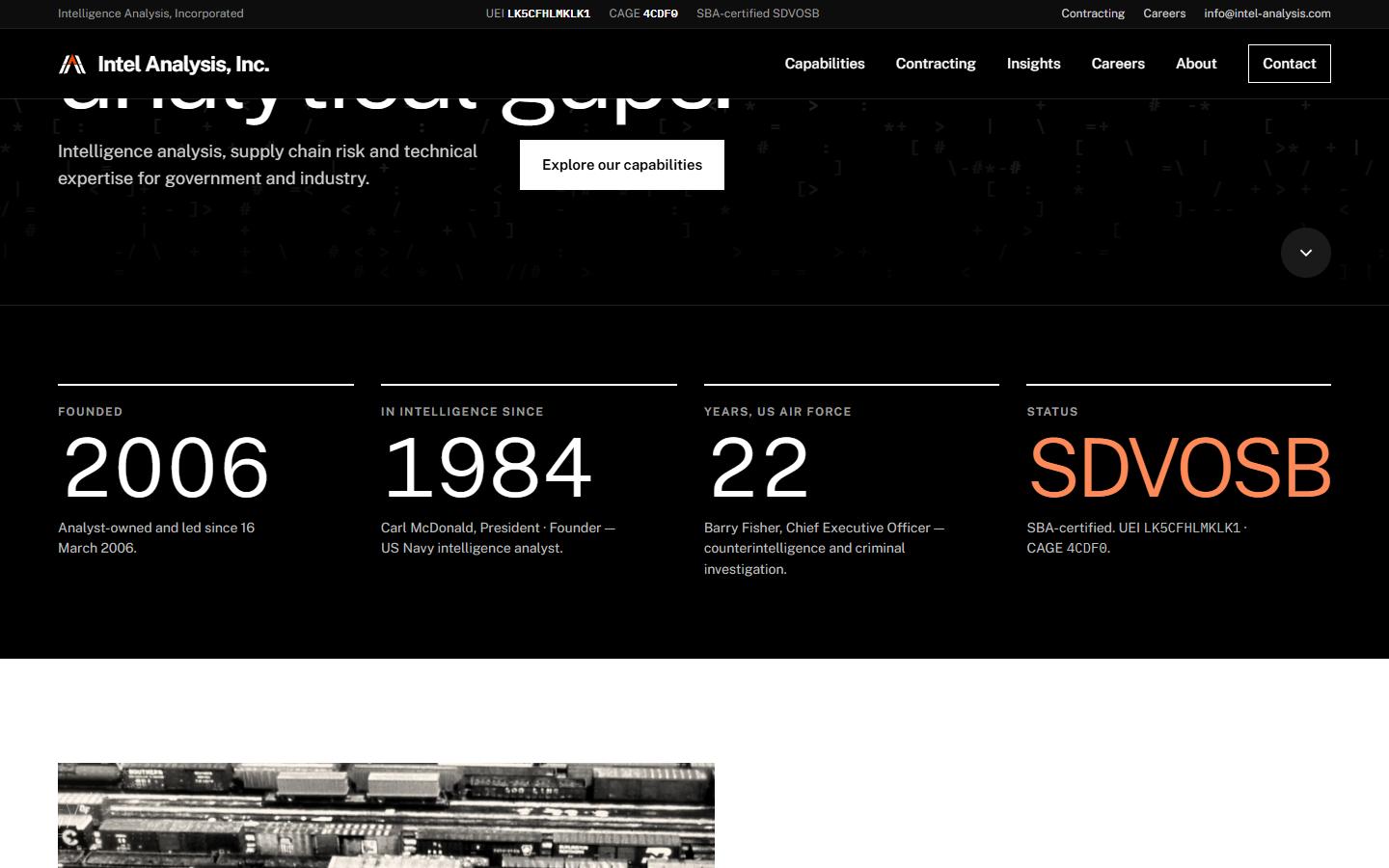
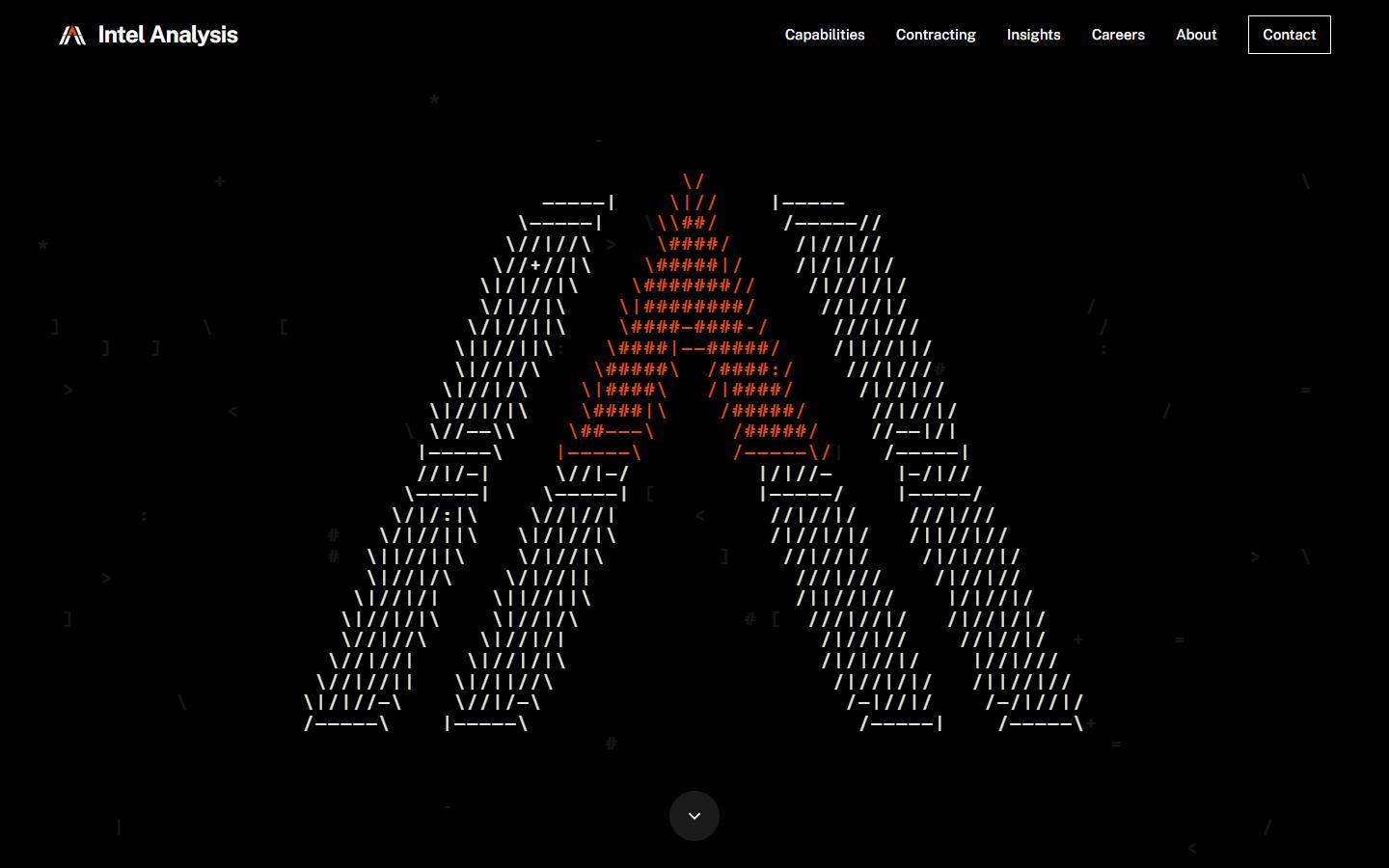
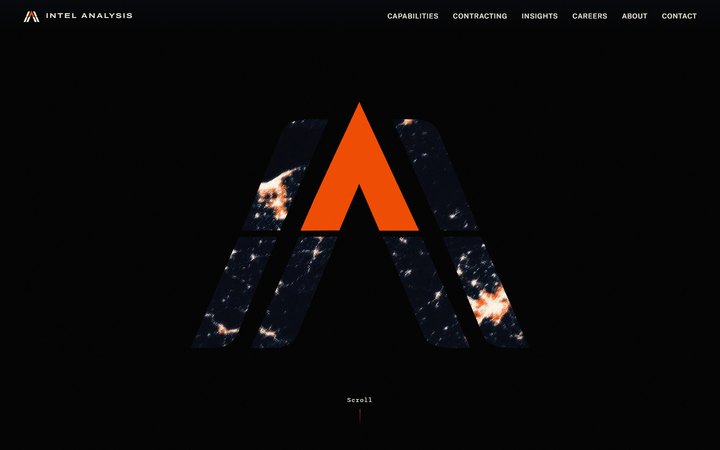
  1. 39Signal Code IILarge-firm system, refinedThe most complete and credible system for a federal audience: proof (UEI, CAGE, SDVOSB) visible on every page, a mega menu, verified figures, and a signature glyph mark. The strongest base for the production site.
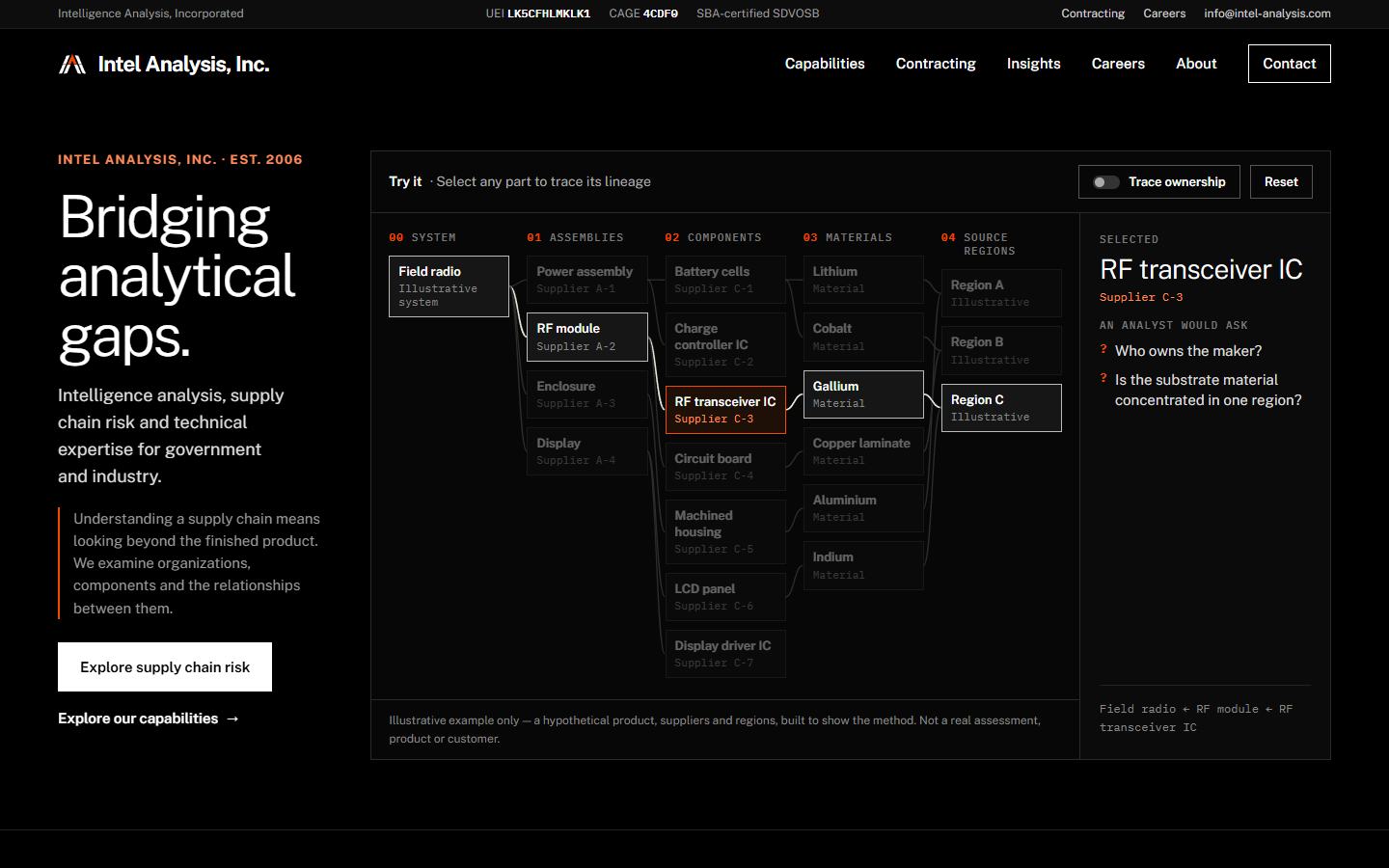
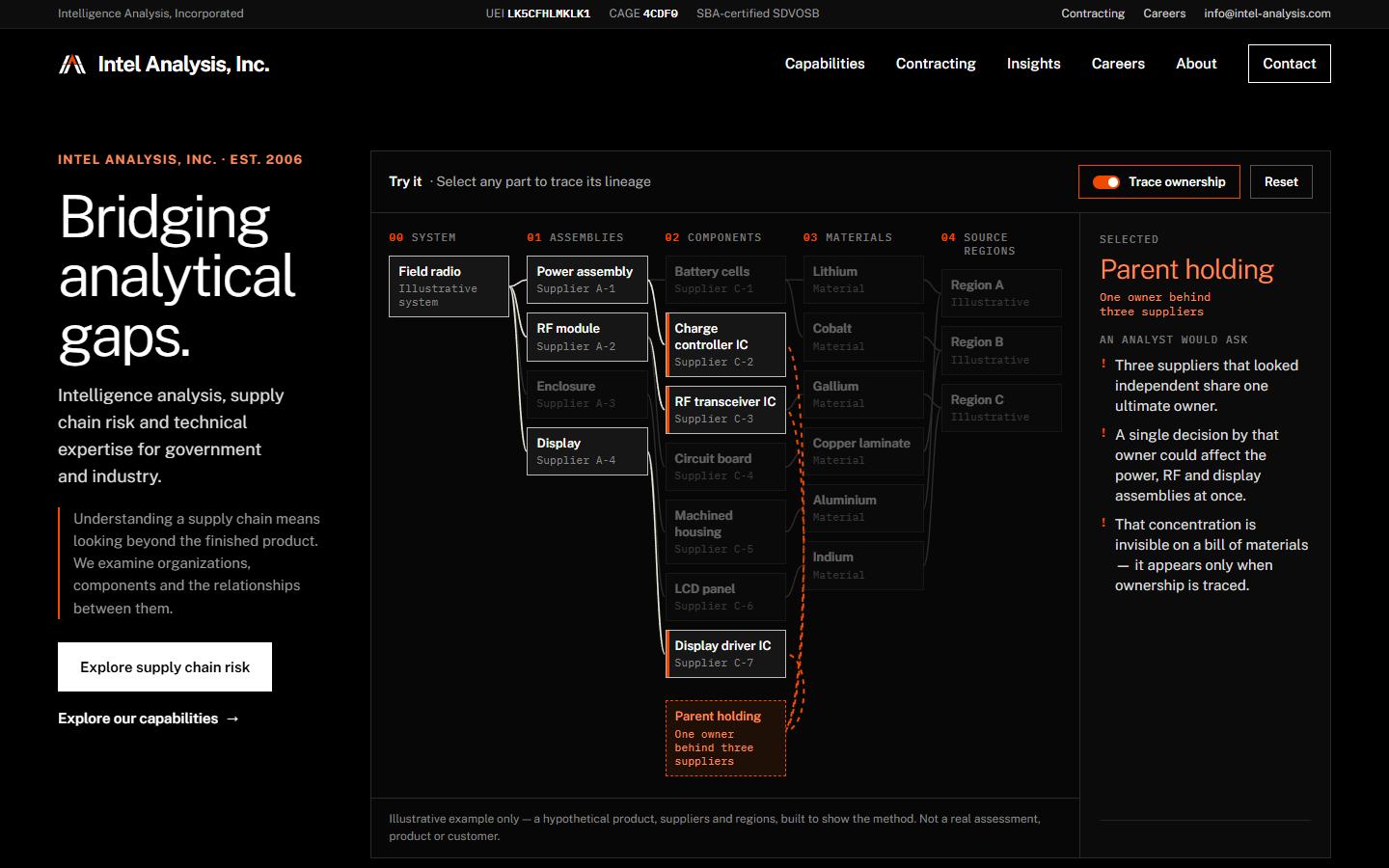
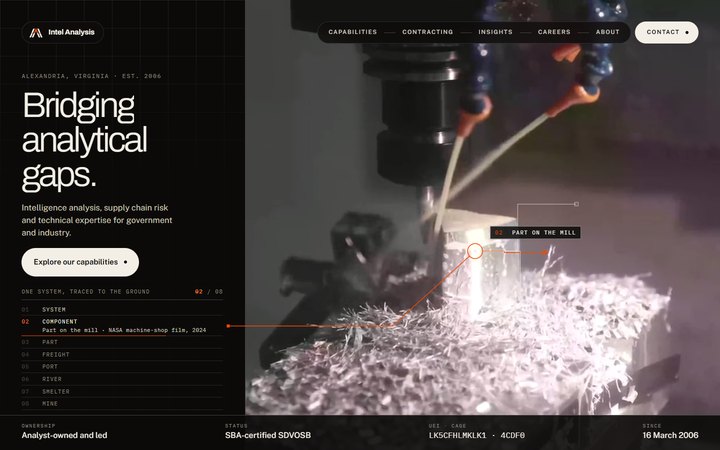
  2. 40LineageInteractive supply-chain explorerThe only concept that demonstrates the work rather than illustrating it — a reviewer can trace a supply chain and watch three “independent” suppliers resolve to one owner. Best used as a section of the chosen site.
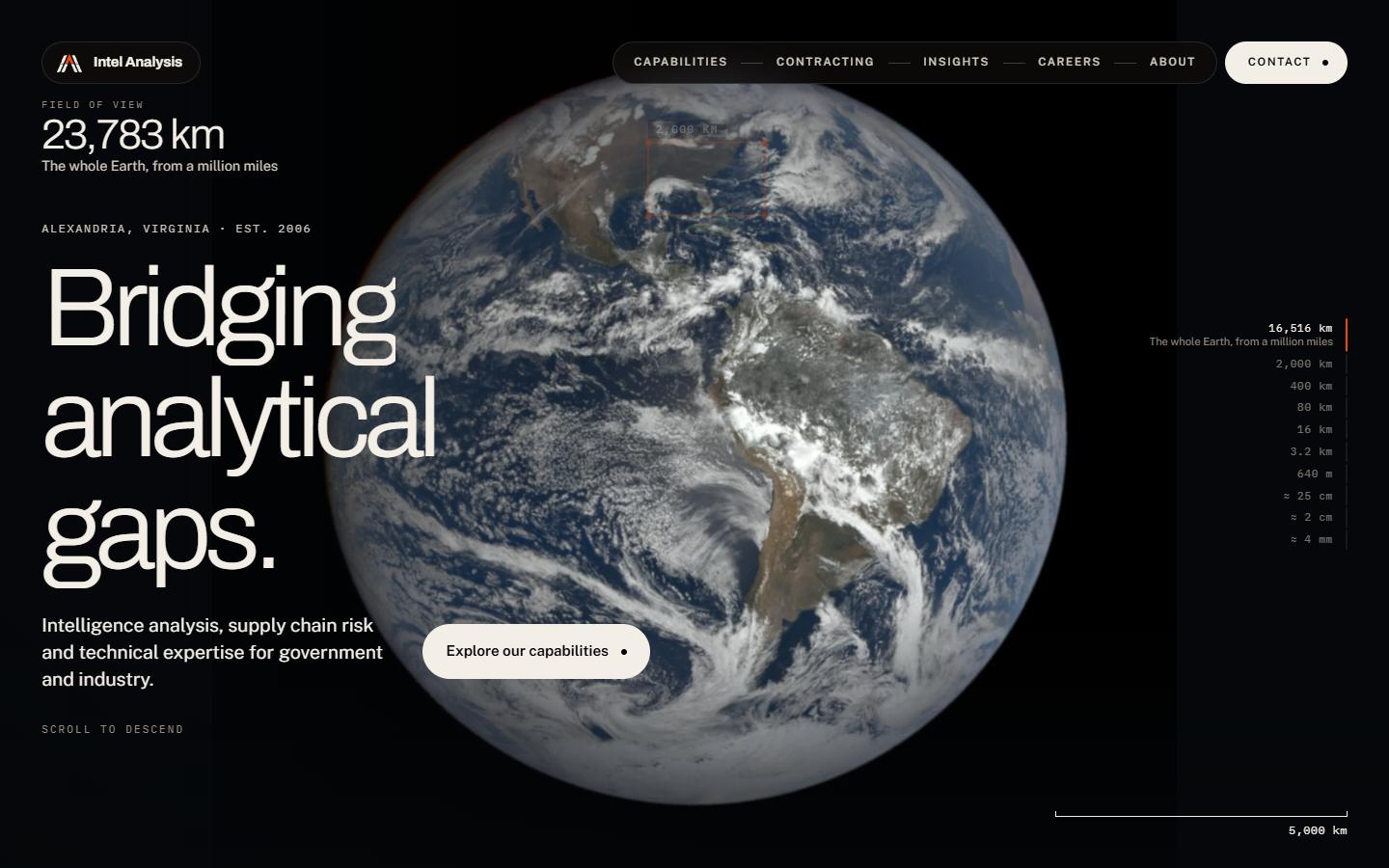
  3. 36DescentEarth to chip, true scaleOne unbroken scroll from the whole Earth to a chip die at true scale. The clearest single image of what supply chain analysis means.

  4. 30Signal / NoiseArchival montage, glitched liveThe boldest: archival film broken and recovered live on the visitor’s GPU. Memorable and shareable, best as a campaign or careers piece.

Chapter I

Ready to build on

Complete, conventional-to-navigate systems with a signature idea. These are the strongest candidates for the production site.

6 concepts
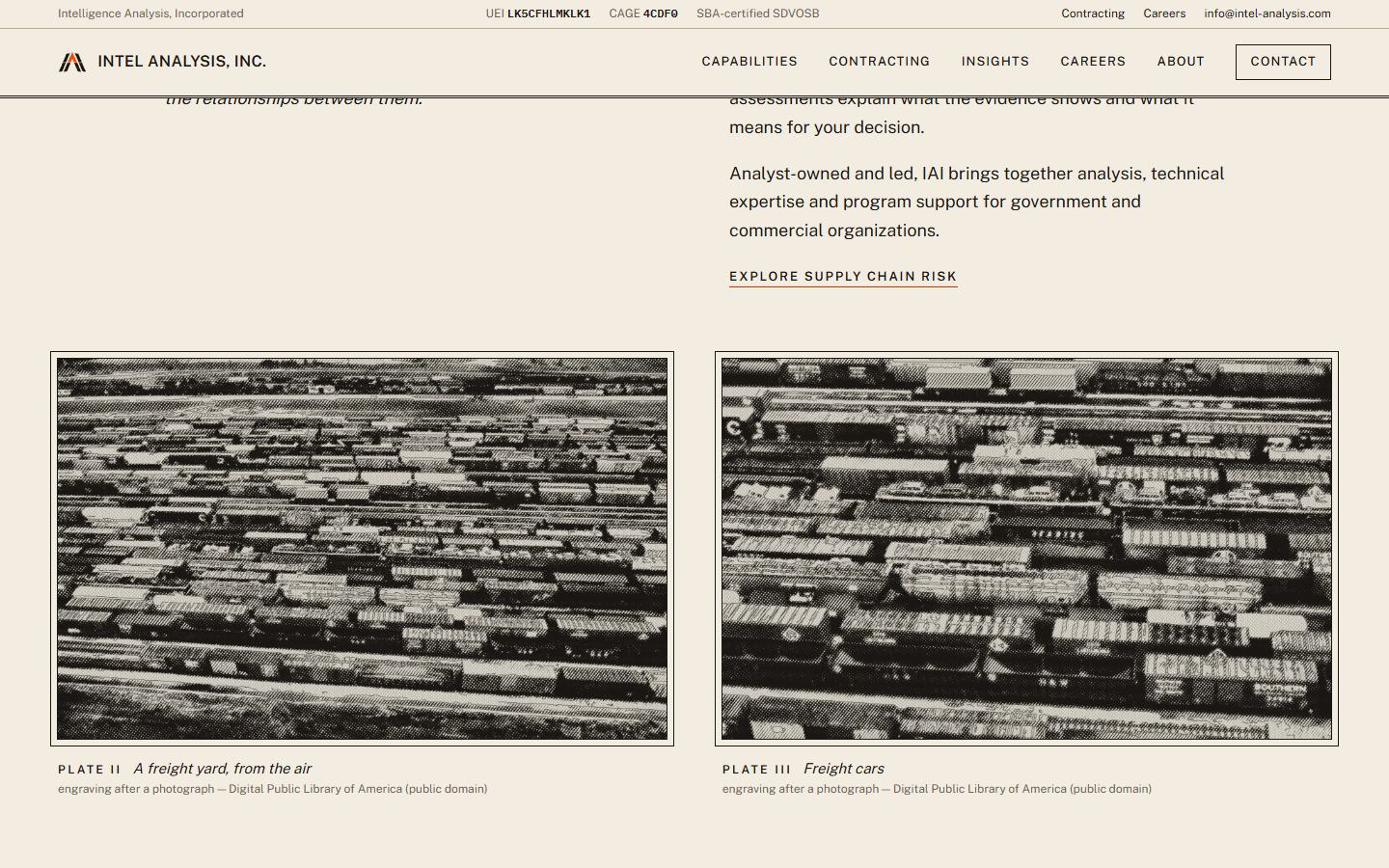
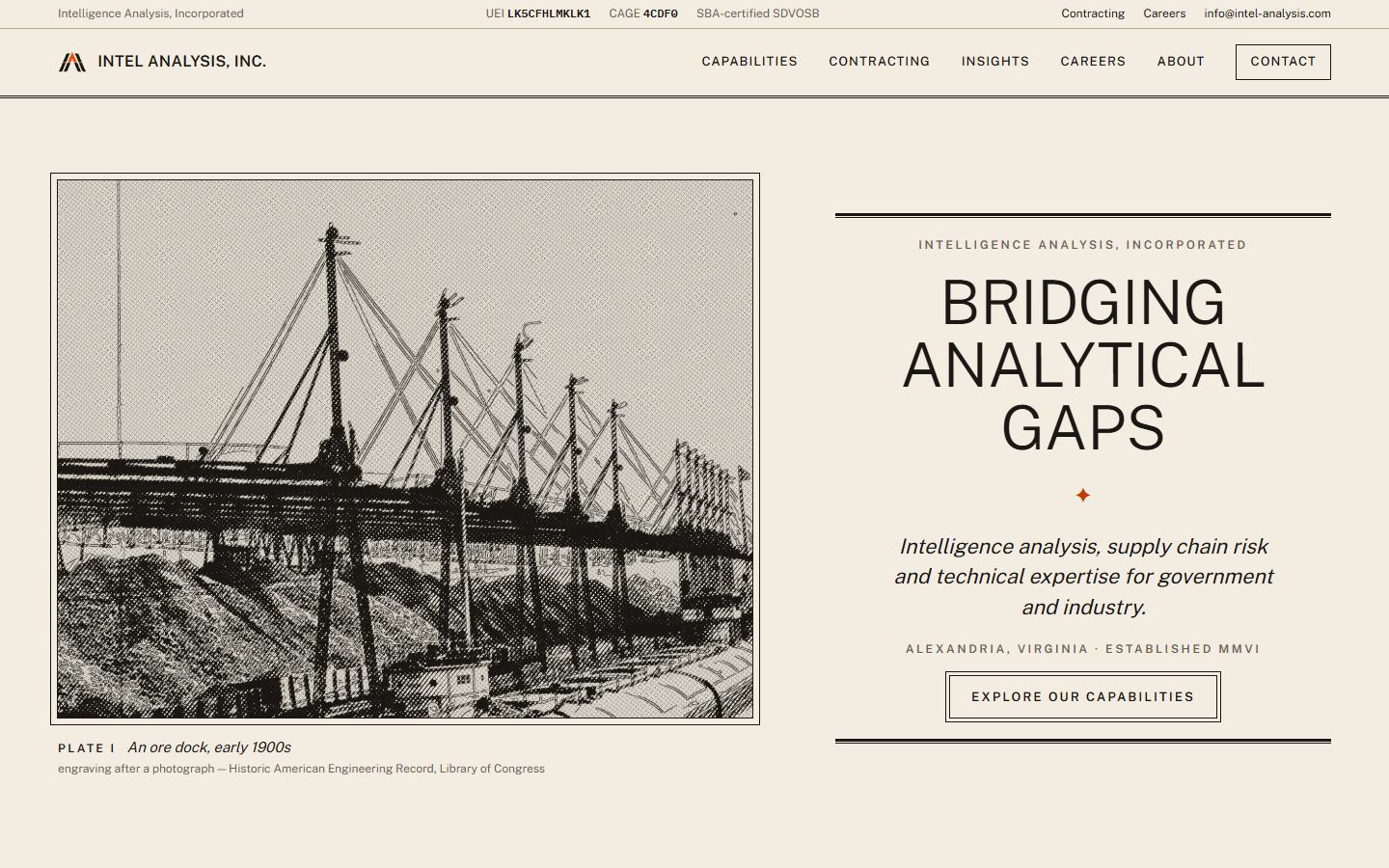
  1. 43Etched Engraved plates, engineering book Illustration instead of photography: every picture is a line engraving computed from a public-domain photograph, set like a fine engineering book — a title page with frontispiece, Roman-numbered plates that engrave themselves into view, a contents page, a colophon. Look for Each plate engraves itself into view; capabilities set as a contents page with leader dots. Engraved platesBook designPaper and ink
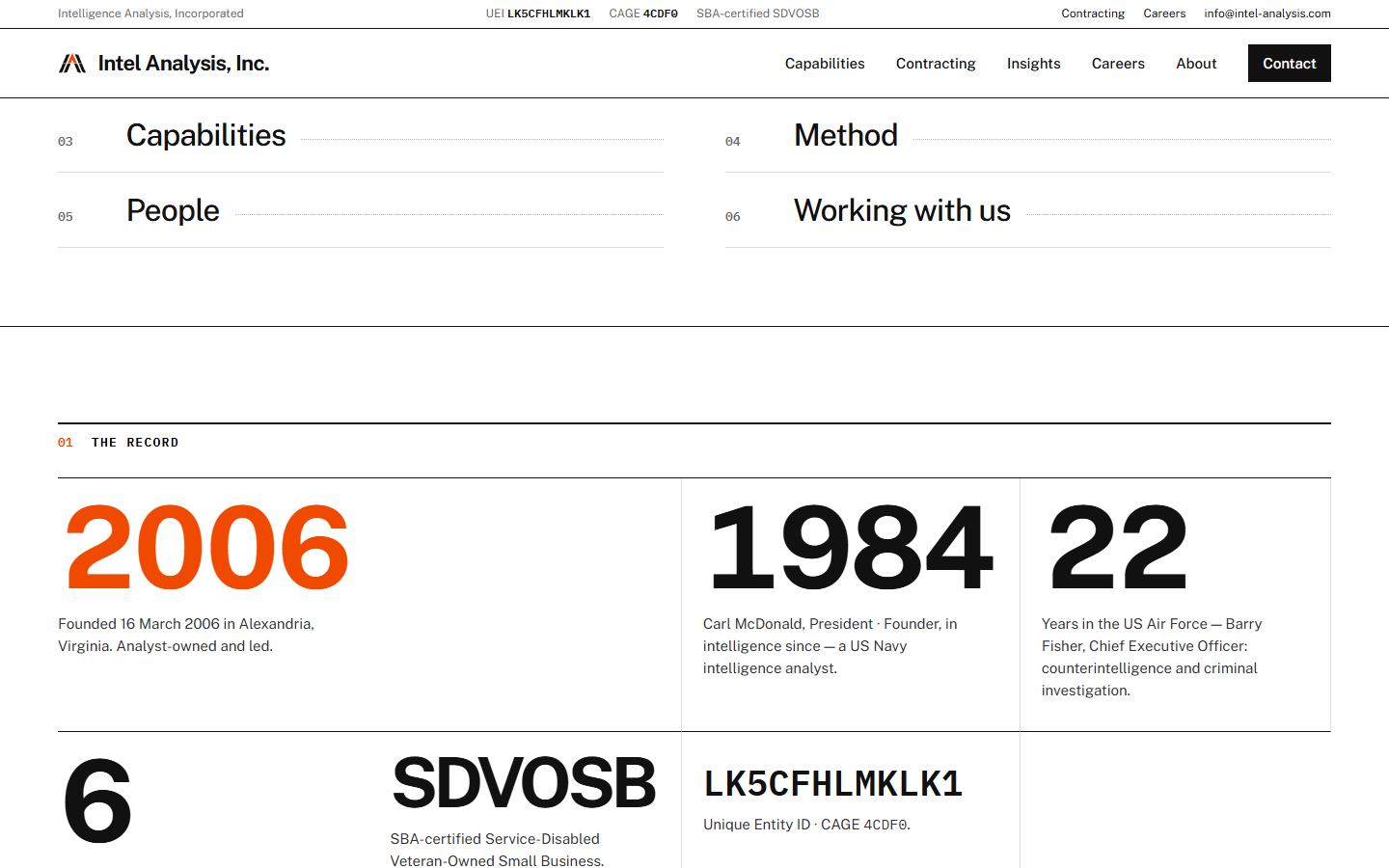
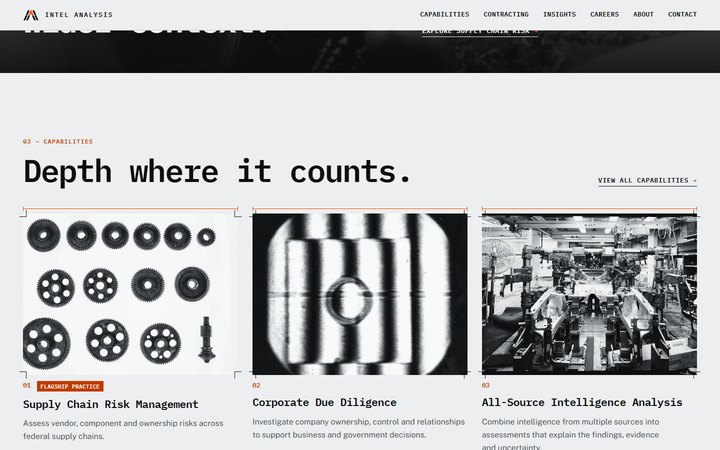
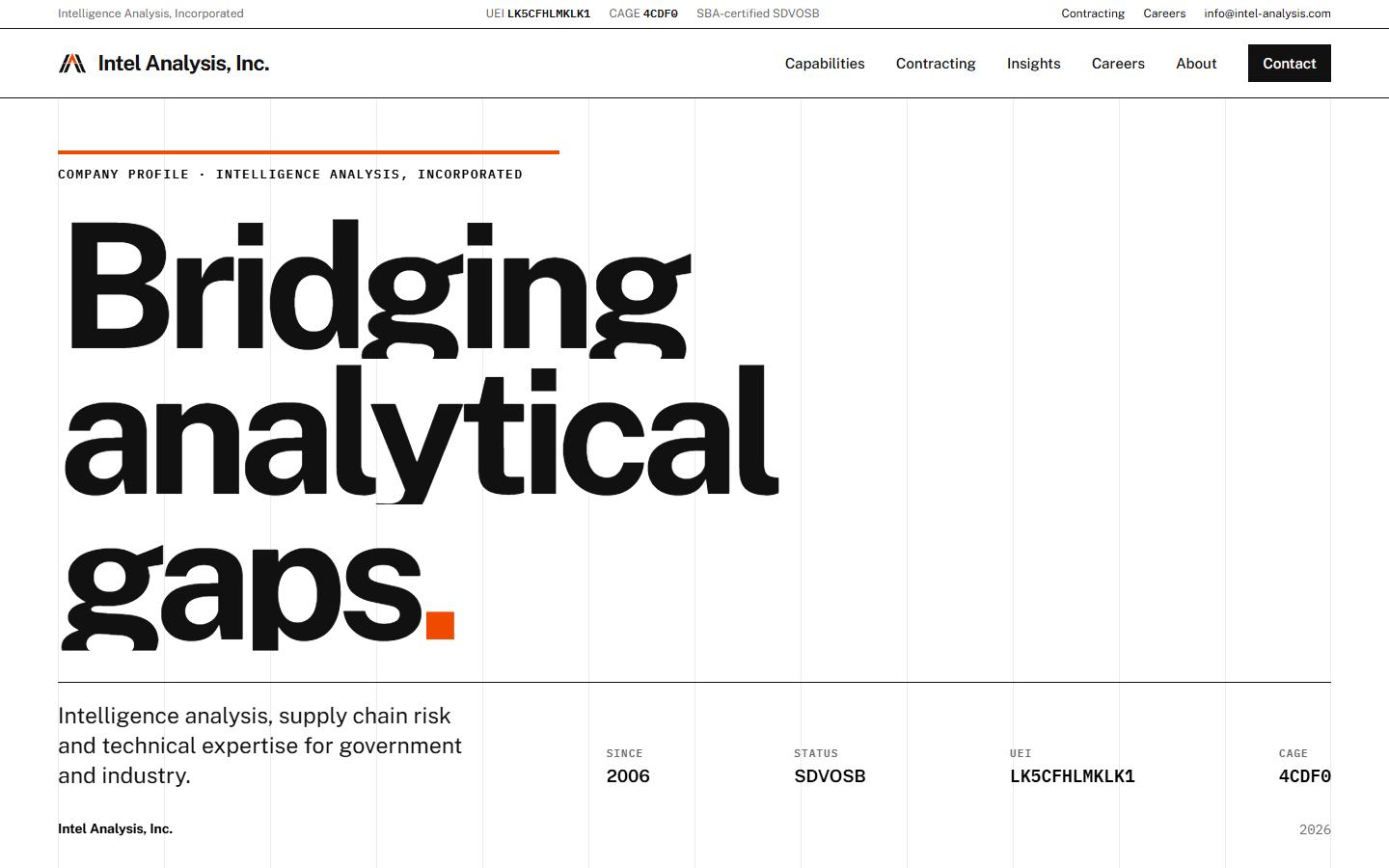
  2. 42Profile Printed company profile The company as a printed report on a Swiss grid: a cover, a contents page and numbered sections. The record set as very large verified figures; capabilities as a numbered table; three plates in duotone. White, black and one spot of orange. Look for A report cover, contents and numbered sections; the record as very large verified figures. No dark backgrounds. Print / SwissTypographicLight theme
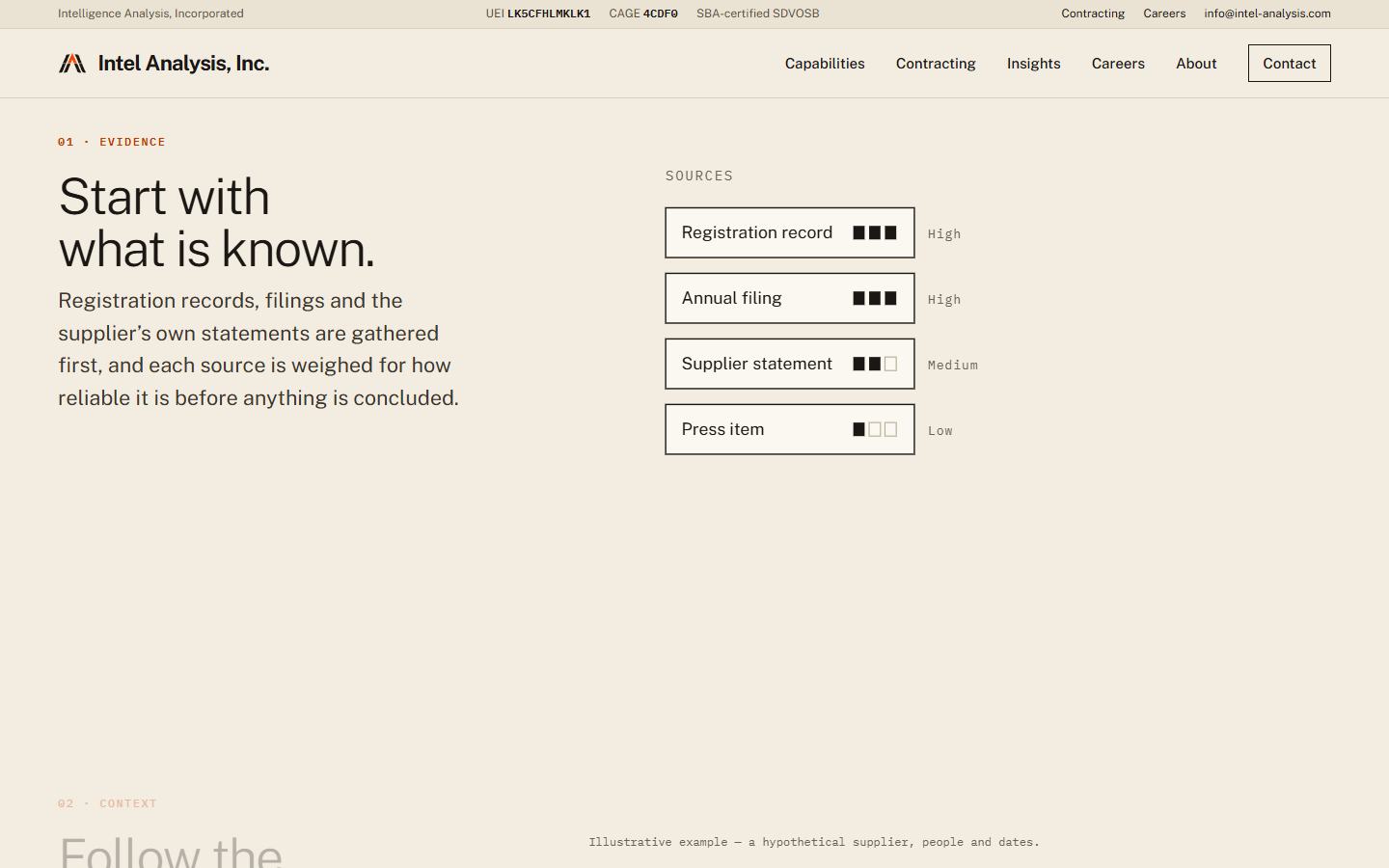
  3. 41Casefile Editorial long read An editorial long read on paper. One illustrative due-diligence question is walked from arrival to finding in IAI’s own order — Evidence, Context, Judgment — while a diagram builds beside the text: sources weighed, an ownership chain, a timeline, a confidence scale, the finding. Look for Scroll the case slowly — the diagram builds beside the text, from the question to the finding. ScrollytellingLight themeReadable
  4. 40Lineage Interactive supply-chain explorer The method, demonstrated. The hero is an interactive explorer of one illustrative product — system, assemblies, components, materials, source regions. Select a part to trace its lineage and see the questions an analyst would ask; switch on ownership and three apparently independent chip suppliers resolve to a single parent. Clearly labelled hypothetical; the rest of the site is the 39 system. Look for Select any part, then switch on “Trace ownership”: three chip suppliers resolve to one parent. The example is labelled hypothetical. Interactive demoHidden ownershipKeyboard accessible
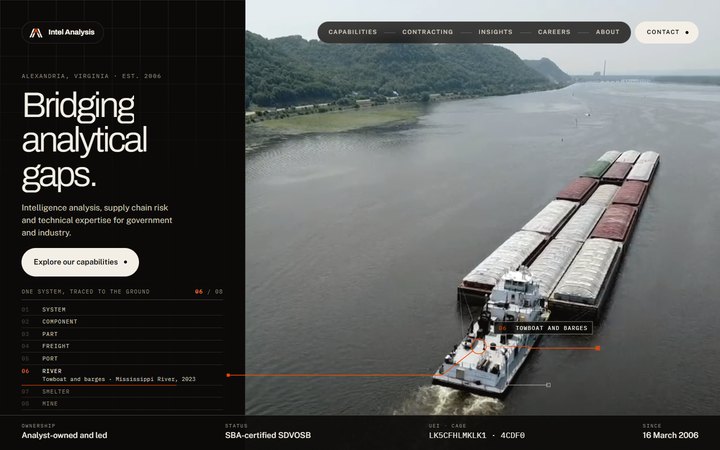
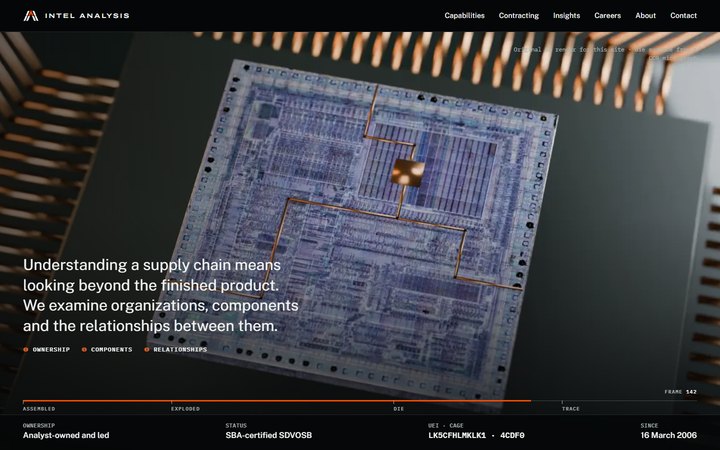
  5. 39Signal Code II Large-firm system, refined 38, improved. The brand reads "Intel Analysis, Inc." A utility bar carries the legal name, UEI, CAGE and SDVOSB status on every page; Capabilities opens a mega menu; the headline sits inside the glyph hero and the mark dissolves back into code as you scroll; a stats band counts up (2006 · 1984 · 22 · SDVOSB); cards reveal their glyph layer on hover; the spotlight has a timed progress dash, counter and arrows; icons draw themselves. Three new photographs: an ore dock (HAER), a tape library, a switchyard. Look for Hover “Capabilities” for the mega menu; watch the iAi mark assemble from code and dissolve as you scroll; the figures count up. Large-firm systemMega menu · statsIntel Analysis, Inc.
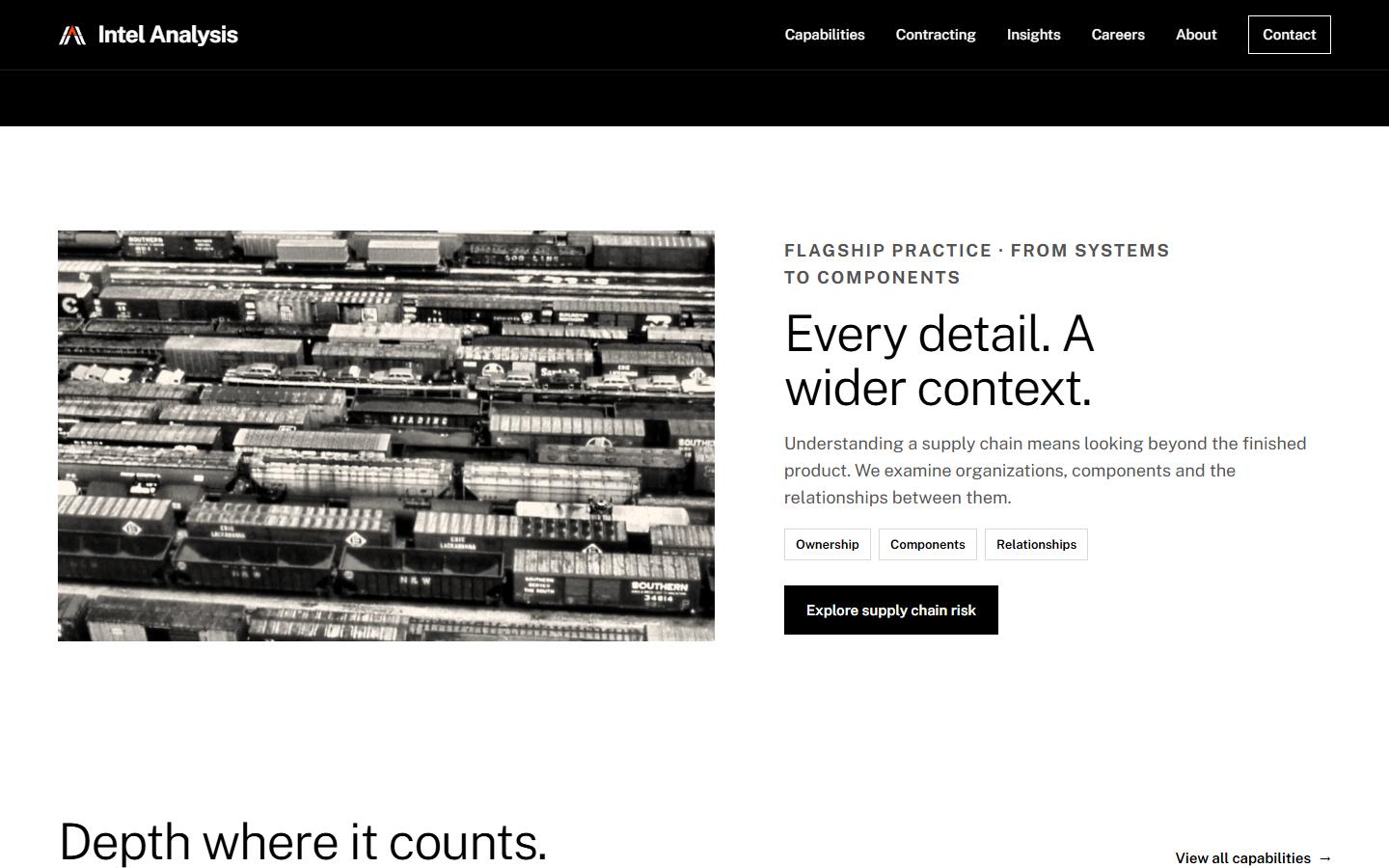
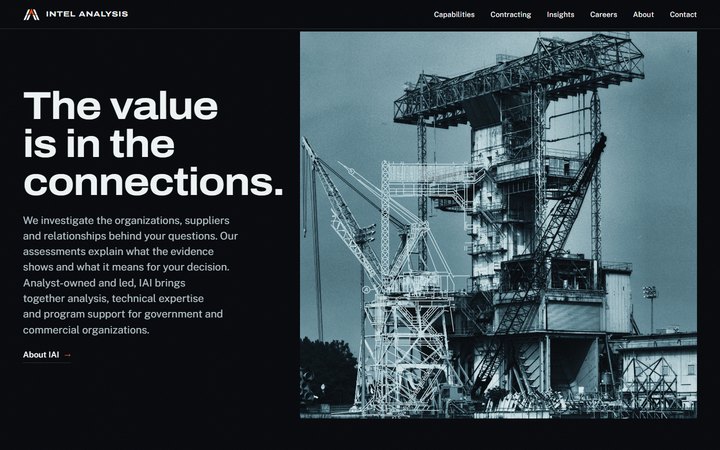
  6. 38Signal Code Large-firm system, after Booz Allen A large-firm system in the manner of Booz Allen — black and white at full contrast, light large type, square buttons, cards with coloured category labels, a spotlight carousel, line-icon tiles, a black footer with a giant wordmark — with IAI's own signature: the iAi mark assembled live from code glyphs (orange apex), and a glyph band sweeping across each photograph. New public-domain photographs: a NARA control room, a freight yard from the air, a refinery at night, a HAER billet furnace, a 1930 parts warehouse. Look for The black-and-white system and the glyph-built iAi mark. Compare with 39 to see what was refined. Large-firm systemGlyph-built markNo space imagery

Chapter II

Film and cinema

Hero films cut from public-domain footage — montage, archival, cinematic.

5 concepts
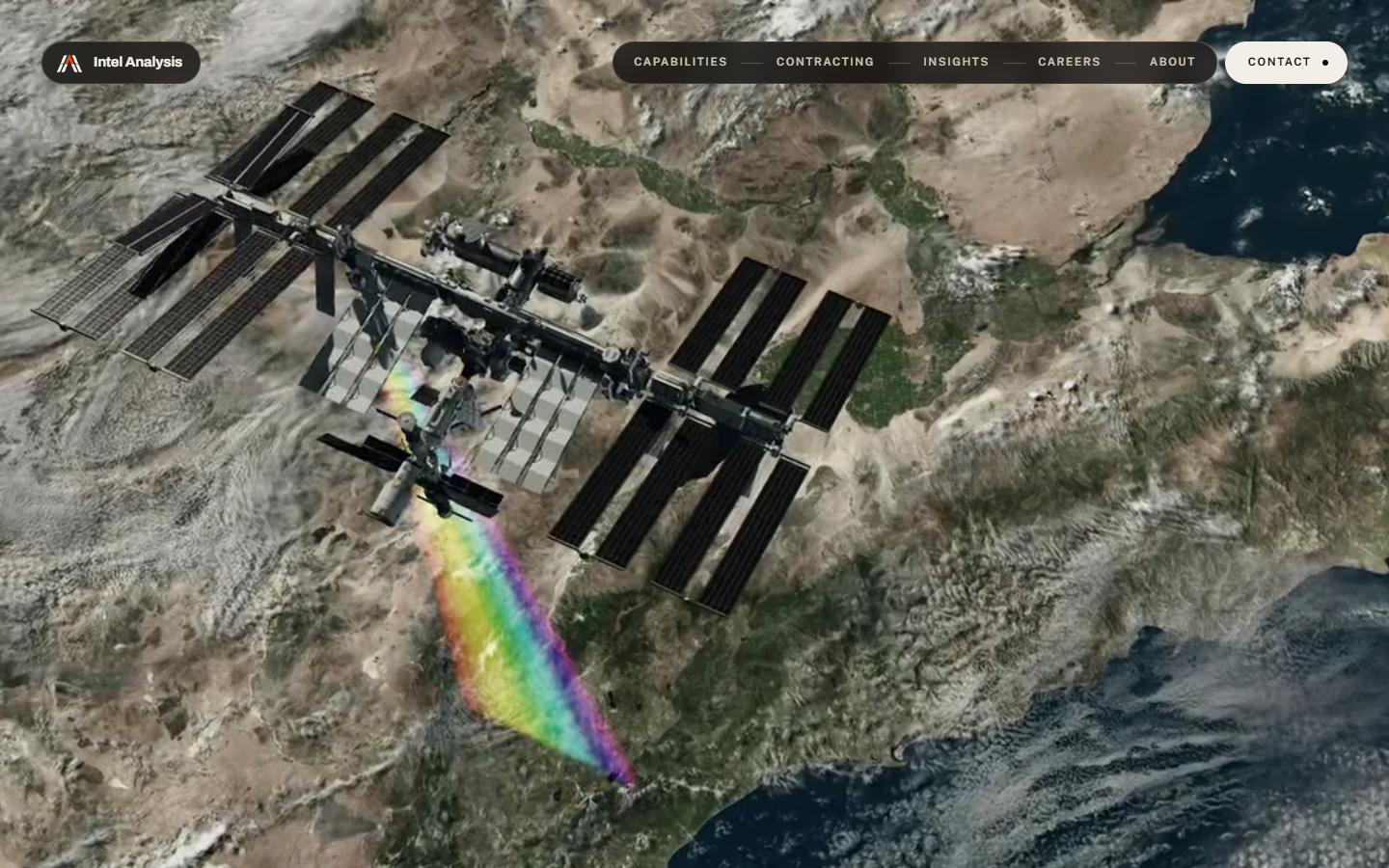
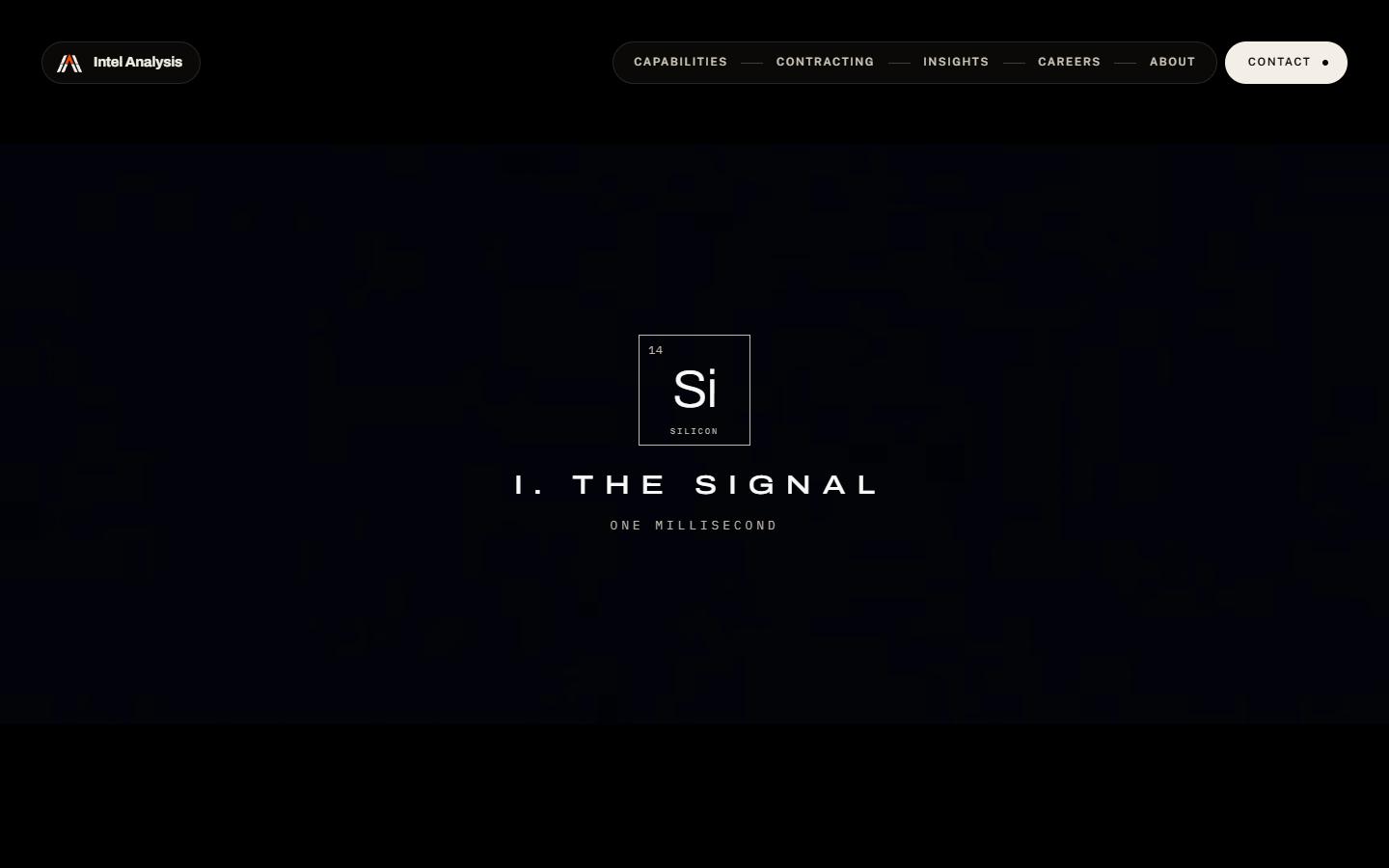
  1. 34Element Cinematic: what technology is made of Nolan, again — about what technology is made of. Three timelines, each with an element tile and its own clock: The Signal (Si), one millisecond — vacuum tubes, an oscilloscope trace, early computers; The Machine (Fe), one day — rollers, a laser cutter, 3D printing; The Element (Nd), one decade, inverted — water running uphill, ore cars, uranium fuel. The frame opens to IMAX on NASA's EMIT spectrometer mapping Earth's minerals from orbit; the coda is lithium ponds in Chile. Look for Turn sound on. Three timelines with element tiles; the frame opens to IMAX on minerals mapped from orbit. Rare earths · data · machinesInverted timelineAll-new footage
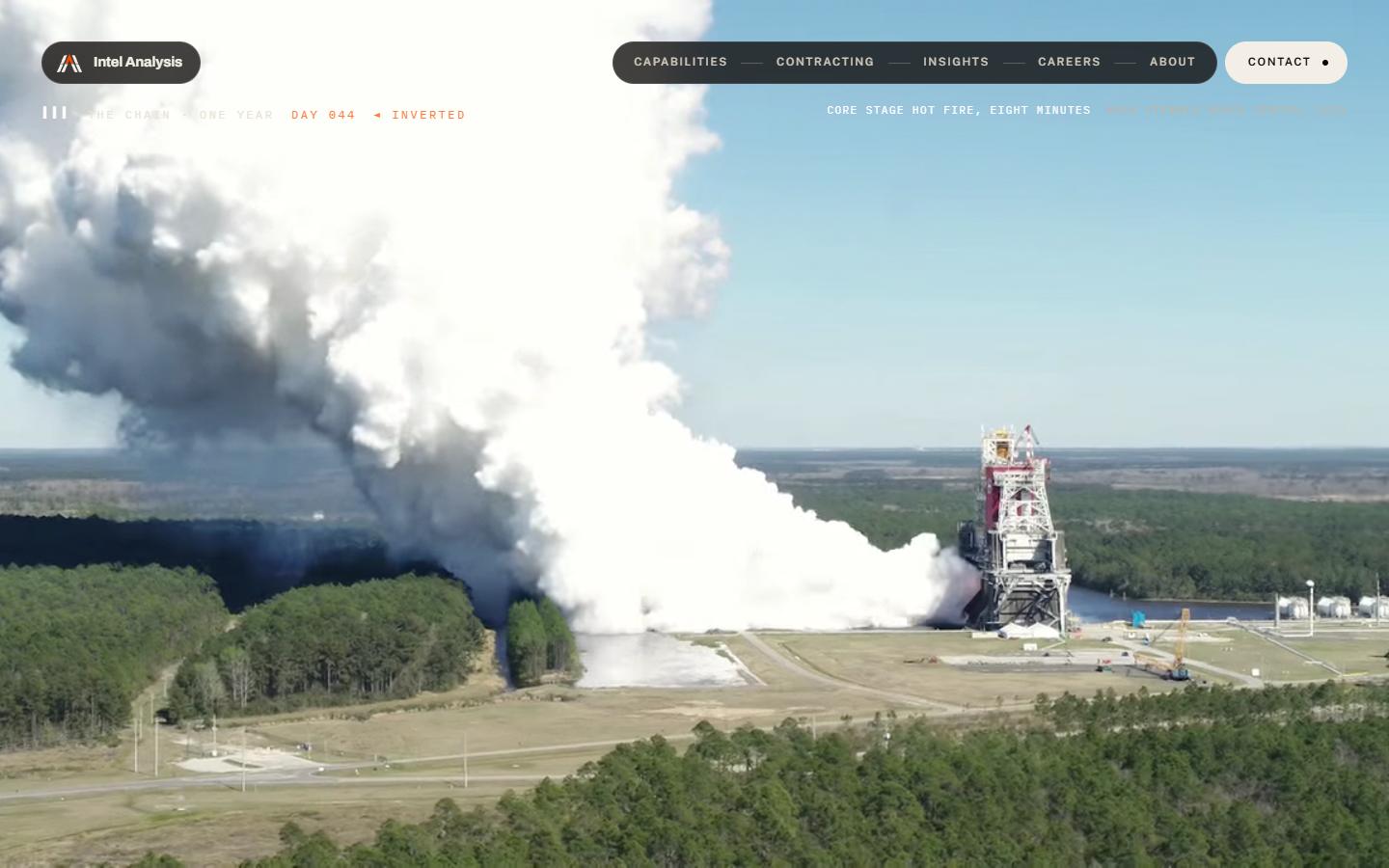
  2. 33Three Timelines Cinematic: three timelines The site as a Christopher Nolan picture. Three timelines intercut at three speeds, each with its own clock: the part, one second (1936, black-and-white); the line, one day (the 1964 crawler-transporter, Bessemer steel, Artemis rolling out); the chain, one year — inverted, played backwards, as an analyst traces it. Cuts accelerate; the 2.39 letterbox opens to the full IMAX frame as a rocket plume returns to its engines. Stark title cards; optional Shepard tone and ticking clock, synthesized live. Look for Turn sound on. Accelerating cross-cuts, one timeline played backwards, the letterbox opening at the climax. Cinematic montageInverted timelineAll-new footage
  3. 28Provenance Footage that draws itself The chain, traced. Eight shots descend a supply chain — compute board, mill, 1936 gear cutting, 1942 rail yard, harbour, river, smelter, mine. Each opens as a live line drawing of itself; a line crosses it and shows the photograph. Graphics are tracked to the subject — the node rides the gear tooth, the crane, the towboat — and an orange wire runs from the index to the thing in the frame. Every page does the same with its own film. Look for Each shot opens as a line drawing of itself; graphics are tracked to the subject in the frame. Footage + live drawingTracked graphicsArchival + modern
  4. 24Reel Ninety years in one reel Ninety years of footage in one reel — 1936 factory film to 2023 Earth from orbit — graded as one film. It plays inside the headline's letters, then fills the screen; a readout names every shot and its year. Every image on the site is a still from the same footage. Look for The montage plays inside the headline letters, then fills the screen; a readout names each shot and its year. Archival + modern montageVideo in typeHouse grade
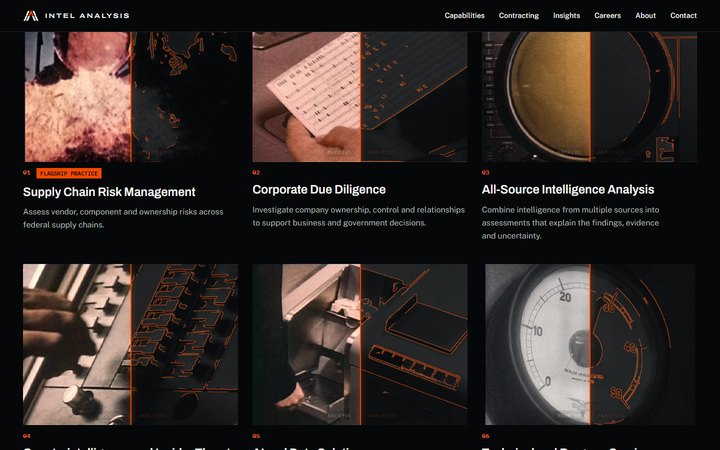
  5. 21Then / Now Archive read by a modern eye Archival industrial film, 1936–1956, read by a modern eye: a WebGL edge detector runs live on the reel and a split sweeps across it — archive on one side, analysis on the other. Stills carry their analysed twin. Look for A live edge detector runs on 1930s–50s film; a split sweeps across it — archive one side, analysis the other. Prelinger archiveLive edge detectionWebGL

Chapter III

New browser technology

Effects only possible in 2026 browsers: live GPU processing, AI depth, real-time relighting.

5 concepts

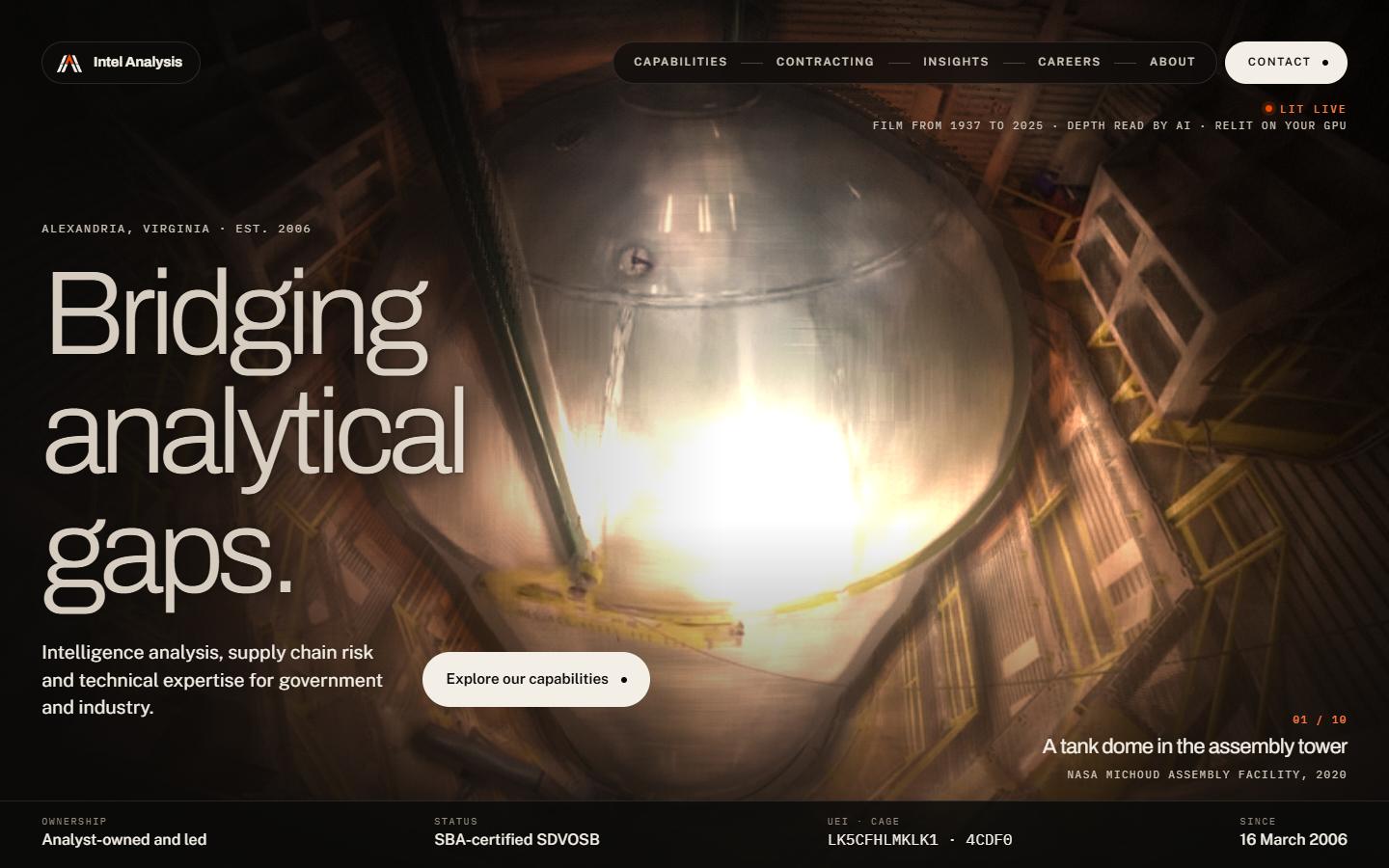
  1. 32Raking Light Archival film, relit live Old film, lit again. All-new footage of how things are made — Precisely So (1937), Aluminum on the March (1956), textile mills (1948), Redwood Saga (1940), Miracle of the Can (1956), NASA Michoud tank domes (2020–25). An AI model read the depth of every frame; in the browser a single moving light relights the film live — real shading, cast shadows, light shafts in the haze — and the rest falls to dark. The headline is lit by the same light. Look for A single moving light relights 1937–2025 footage with real shading and shadows, computed from AI depth. AI depth + WebGPU relightAll-new footageCinematic, calm
  2. 31Disruption How a disruption travels How a disruption travels — slower, calmer, easy to read. A 40-second film of public-domain footage: Hurricane Milton from the space station (2024), lightning, a river gauge and flood from The River (1937), Reno under water (1927), cargo ships on the Delaware (1955), freight in snow and a yard from Mainline U.S.A. (1957), the line open again. In each shot a disruption spreads from one point as a ring — pixel-sorted, in orange — and the frame recovers behind it; cuts melt with a slow datamosh. WebGPU, live. Look for Long, calm shots; in each, a ring of disruption passes through the picture and the frame recovers. Supply chain disruptionWebGPU shockwaveNew archival footage
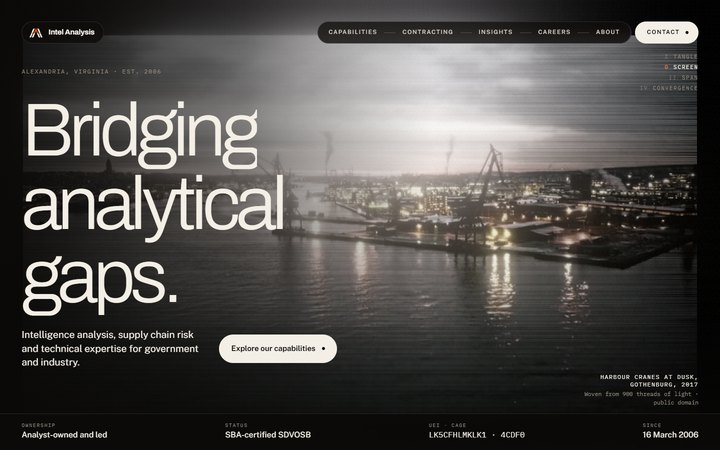
  3. 30Signal / Noise Archival montage, glitched live Archival film, broken and recovered live on your own GPU. A 22-shot hard-cut montage — punch cards, 1936 gear cutting, poured copper, 1942 locomotive wheels, harbour, barge, Saturn V ignition, RS-25 test fire, Earth at night — runs through a WebGPU chain: real datamosh from live motion estimation, pixel sorting, slit-scan, macroblock tearing, each hit timed to a cut. Scroll recovers the signal: the meter climbs, the breakage subsides, orange gives way to true colour. Opt-in synthesized sound. Look for Every cut lands with a live GPU effect; scroll and the signal meter climbs as the picture clears. Sound is optional. WebGPU computeDatamosh · pixel sortArchival montage
  4. 22Signal Forty-eight thousand points One live field of 48,000 points condenses out of noise into a picture, then flows as you scroll from the ground to the metal to the silicon — and resolves into the iAi mark. Every image on the site is printed in points. Look for A live point field condenses out of noise into pictures and resolves into the iAi mark. WebGL particlesStipple printMorph by scroll
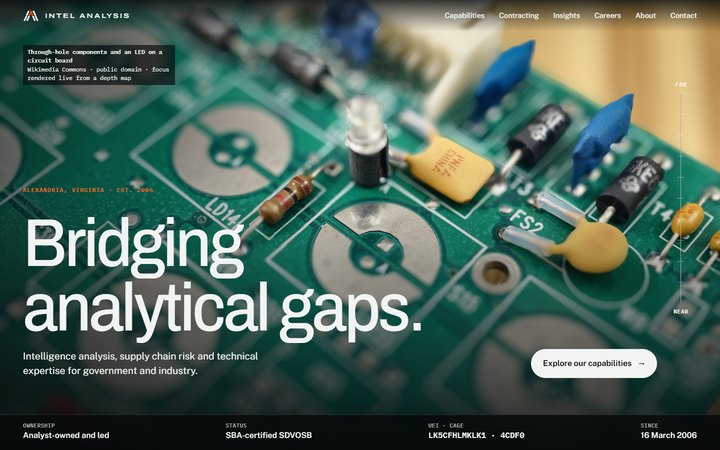
  5. 19Focus Live rack focus Macro tech through a lens. The hero's depth of field is rendered live in WebGL from a macro photograph and its depth map: it racks into focus on arrival, then through the board as you scroll. Look for Depth of field rendered live from a macro photograph: it racks into focus on arrival and through the board on scroll. Live depth of fieldMacroWebGL

Chapter IV

Data, place and scale

Orbital data, true-scale geography and product-style presentation.

4 concepts

  1. 37Keynote As if Apple made it The site as Apple would make it. White space, very large centred type, pill buttons, a frosted global nav. One object shown like a product: NASA's Fermi spacecraft turning on black — slowly in the hero, then scrubbed frame by frame with scroll (120 frames) while three short beats of copy come and go. A bento grid of verified facts, a capability carousel, three-step method cards. Look for The spacecraft turns slowly in the hero, then is scrubbed frame by frame as you scroll the black section. Product-page grammarScroll-scrubbed turntableAll-new imagery
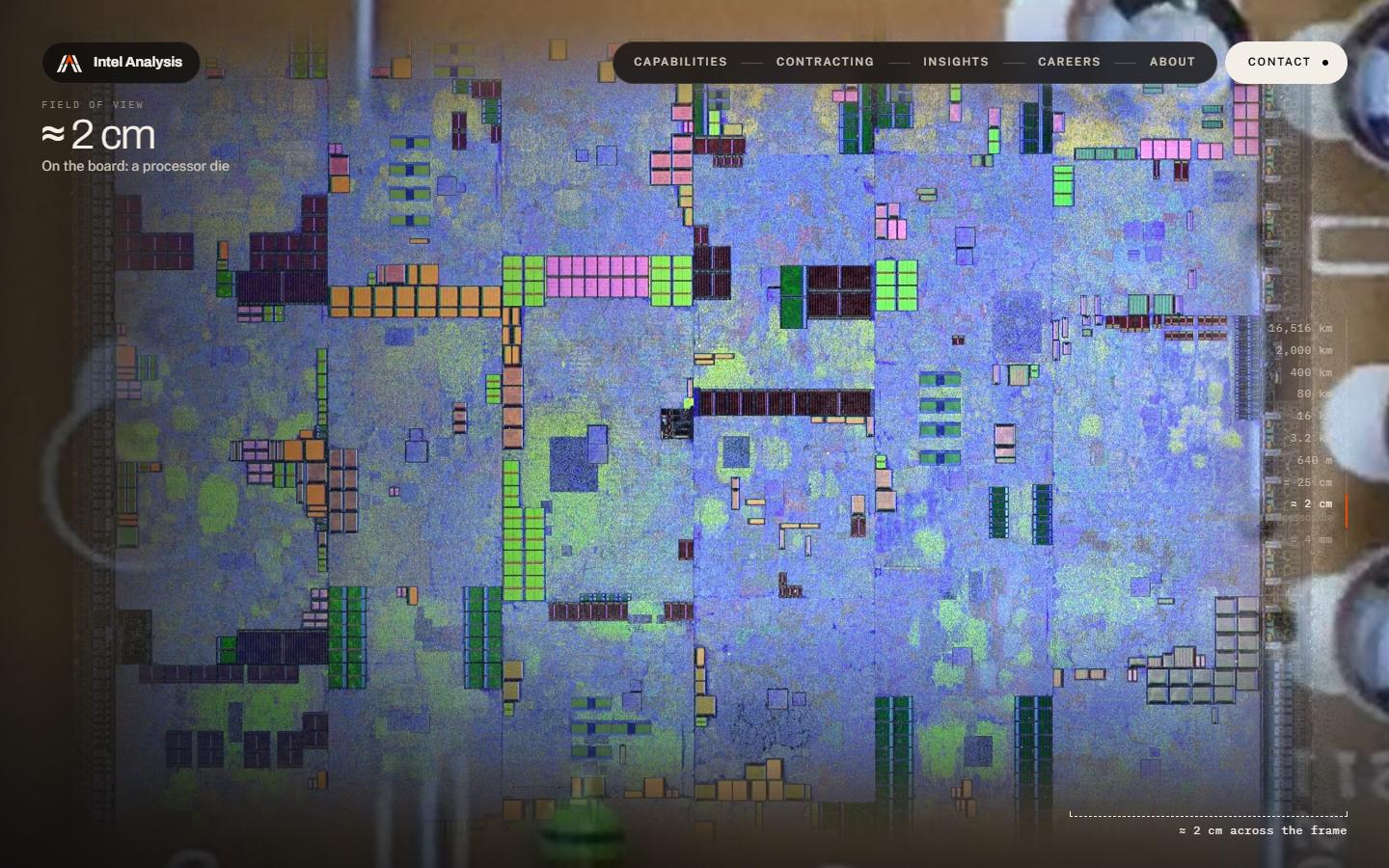
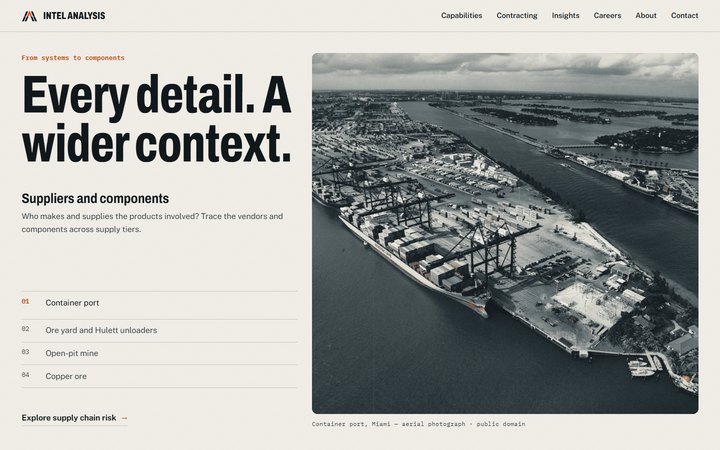
  2. 36Descent Earth to chip, true scale one unbroken scroll from the whole Earth to a chip die. NASA EPIC and VIIRS from the same day, then USDA aerials — every layer centred on one container terminal with an exact ground width, so the field-of-view readout and scale bar are true at every moment. Each step frames the next as a square, after the Eameses' Powers of Ten; below 640 m the descent goes inside one box — a circuit board, a processor die, its circuitry. The analyst's job, shown rather than told. Look for Scroll slowly from the whole Earth to a container terminal, then inside one box; the field of view and scale bar are exact. Earth → die, one scrollTrue scaleAll-new imagery
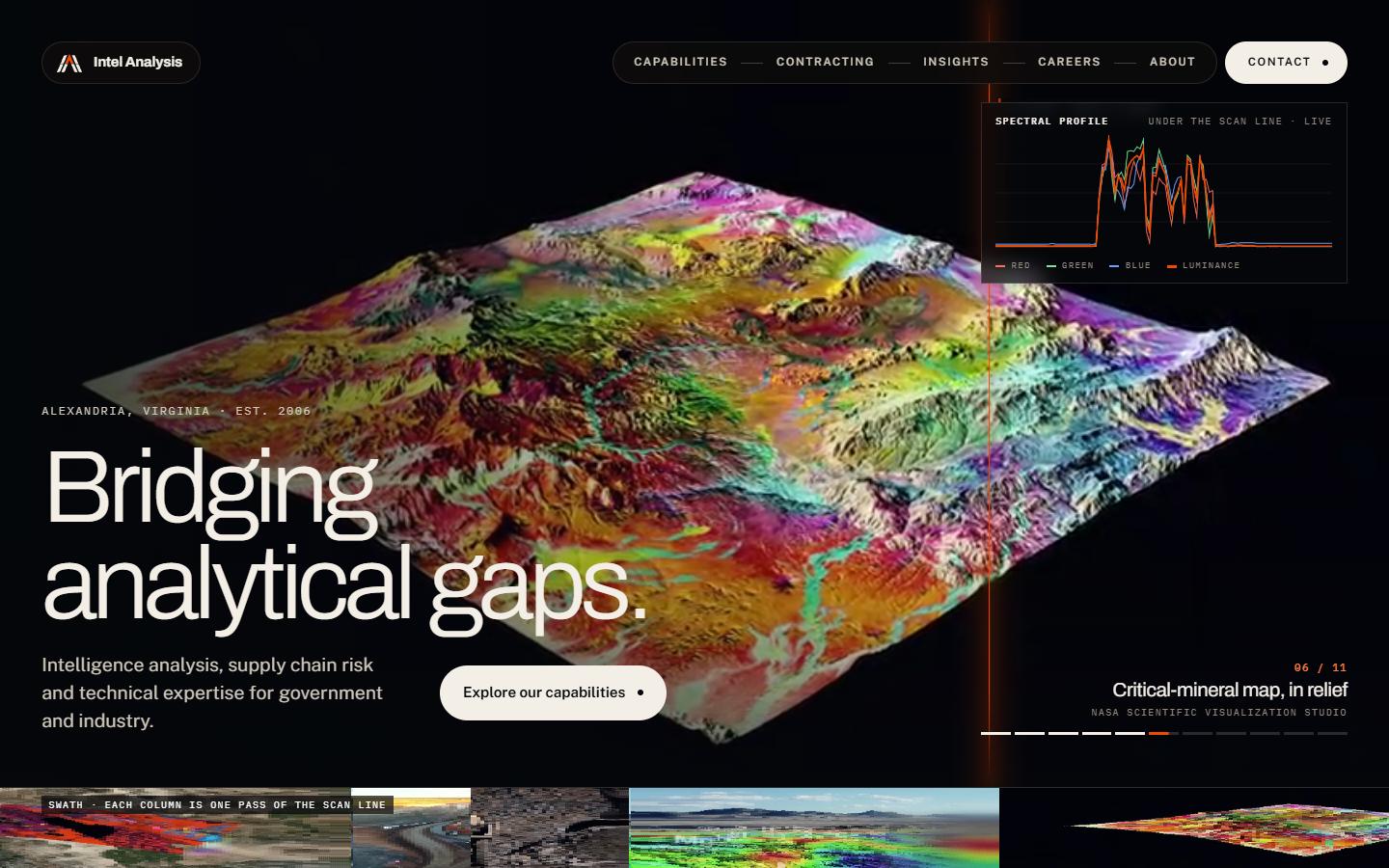
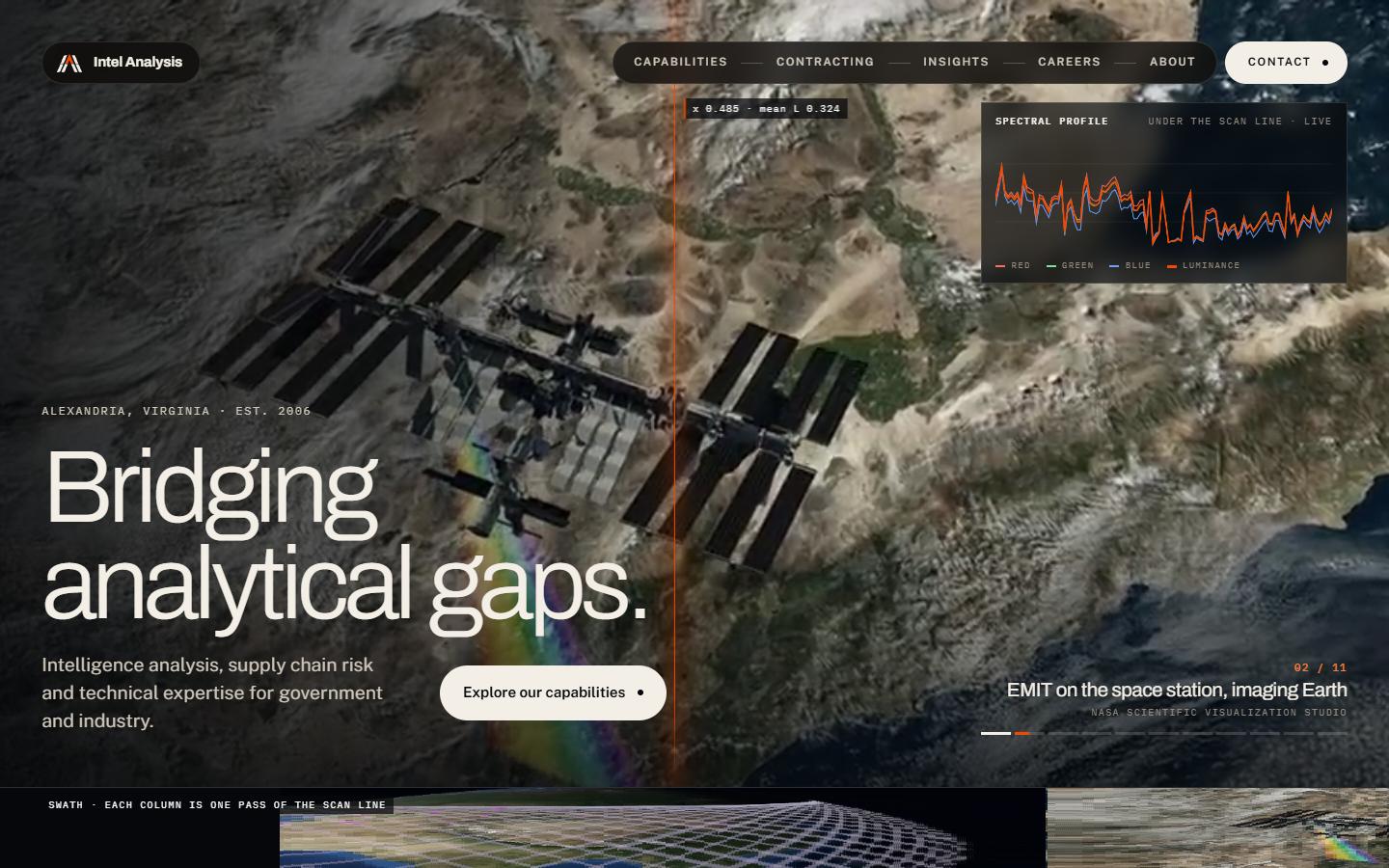
  3. 35Swath Orbital data, read live The view from orbit, read as data. NASA Scientific Visualization Studio films — EMIT mapping surface minerals and methane from the space station, critical-mineral maps in relief, mine drainage, PACE orbit swaths, Landsat + GEDI biomass. A scan line sweeps each shot; a live spectral profile is plotted from the pixels under it; and a strip records every pass as a pushbroom image — all computed in the browser from the footage itself. Look for A scan line sweeps each shot, a spectral chart is drawn from the footage, and a strip records every pass. Live data from the filmOrbital mineral mappingAll-new footage
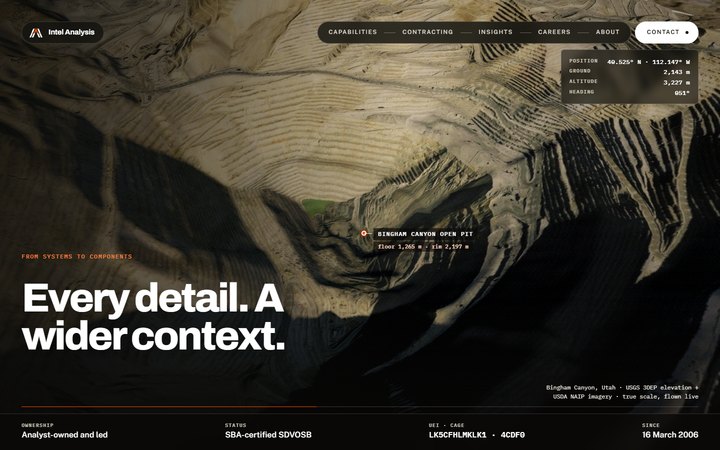
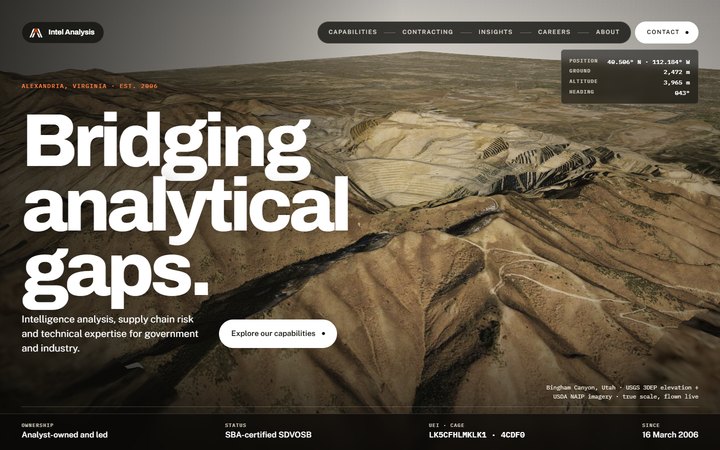
  4. 25Ground Truth A real mine, flown at true scale A real place flown live at true scale: Bingham Canyon, Utah, from USGS elevation and USDA aerial imagery. Scroll carries you over the Oquirrh Mountains, down over the open pit, and up to the Salt Lake Valley, with a live position and altitude readout. Every page carries an aerial of a real place, with its coordinates. Look for Scroll flies over Bingham Canyon from USGS elevation and aerial imagery, with a live position readout. Live 3D terrainReal dataSurvey-sheet theme

Chapter V

Objects and sculpture

Live 3D objects and generative sculptures as the hero.

6 concepts
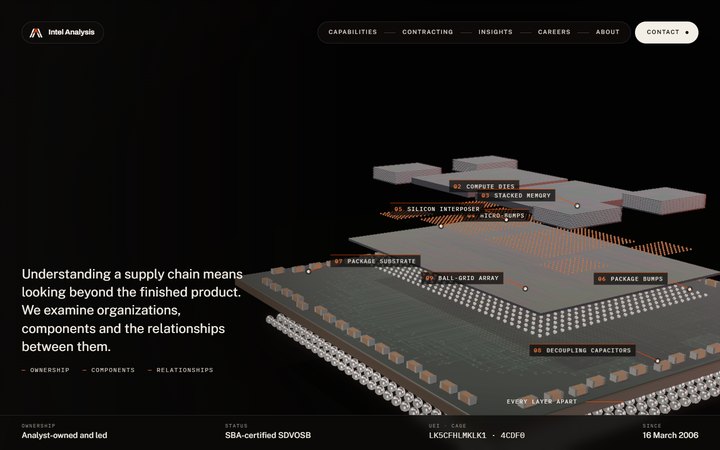
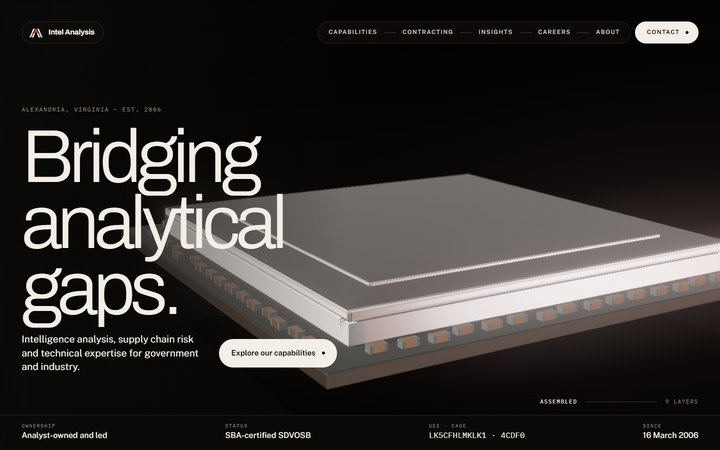
  1. 29Inside Product film of a chip package Know what is inside. A product film rendered live: an illustrative advanced semiconductor package — heat spreader, compute dies, stacked memory, interposer, bumps, substrate — modelled for the site and lit by a real photo studio (CC0 HDRI). Silicon shows thin-film colour as the light crosses it. Scroll takes it apart layer by layer, each layer labelled where it sits, then shows the stack side on. Kinetic type on Archivo's width axis. Every page shows the package from its own angle. Look for Scroll takes an illustrative semiconductor package apart layer by layer, each layer labelled. Live PBR product filmProcedural modelKinetic type
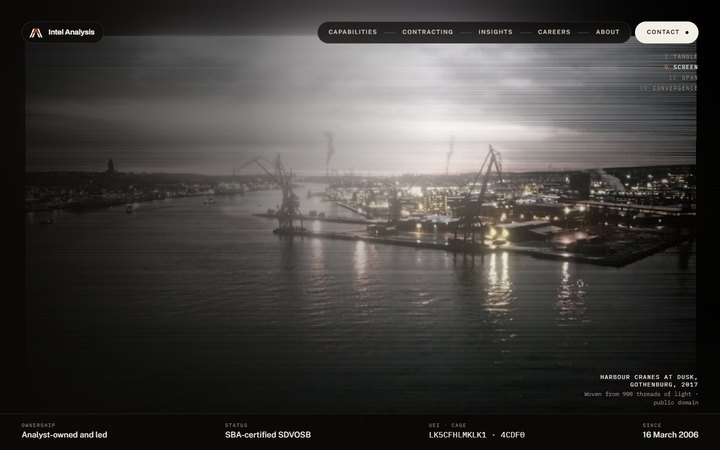
  2. 27Woven Film woven from threads Film woven from threads of light. A reel of archival and modern footage — 1936 factory film to Earth from orbit — plays as a woven screen: every thread is one row of the picture. It condenses out of a tangle on arrival, then scroll unravels the picture into a span and a convergence, the footage still running through the threads. Every page weaves its own film, then unravels it into its study. Look for The reel plays as a woven screen of light threads that unravels with scroll. Video as textureLive WebGL threadsArchival + modern
  3. 26Thread Live thread sculpture A gallery, not a briefing room. A live sculpture of 900 luminous threads is strung on arrival, resolves into a span across a gap, then re-forms with scroll — tiers, convergence, one thread traced. Every page has its own thread study. A leadership spread for Carl McDonald and Barry Fisher in verified facts only. Look for A sculpture of threads strung live, re-forming with scroll. Live WebGL sculptureNo intel tropesPage-specific studies
  4. 23Keystone The iAi mark, machined in 3D The iAi mark as a machined object, rendered live: titanium legs, an orange glass chevron lit from within. It assembles under a sweeping light, separates into the three pillars, takes the camera into the glass, and closes as a seal. Every page's photograph chosen for its subject. Look for The logo as a lit titanium-and-glass object: it assembles, separates into the three pillars, and closes as a seal. Three.js, liveThe mark as heroPage-matched art
  5. 20Teardown A chip comes apart An original 3D render, scrubbed by scroll: a chip on its board comes apart — lid, die, solder — and the camera drops onto the silicon as routes light from pin to core. Chapters of copy arrive with each act. Look for An original 3D render scrubbed by scroll: lid, die, solder, then routes light from pin to core. Original Blender renderScroll-scrubbed180 frames
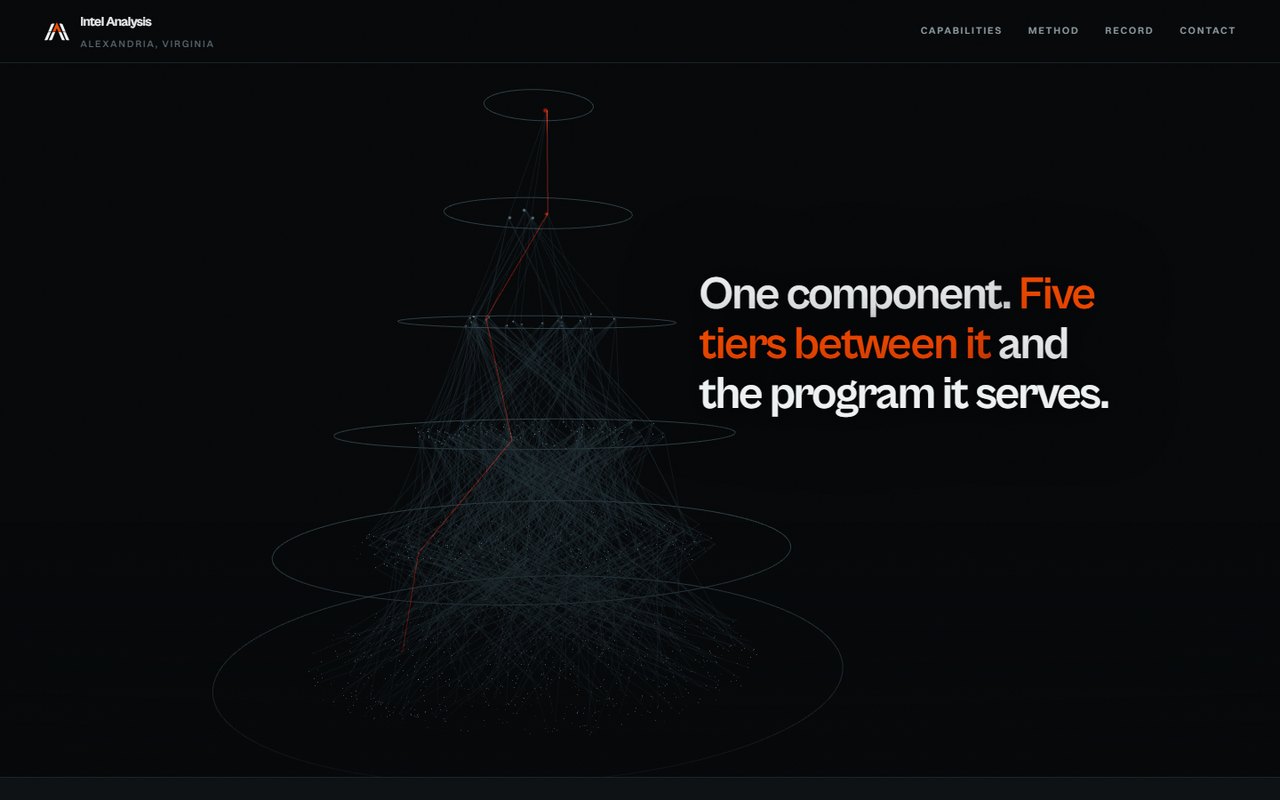
  6. 01Tier Descent The first concept: a descent through tiers A WebGL camera falls through mission, prime and three supplier tiers to origin. Look for A live 3D camera falls through mission, prime and supplier tiers to the origin. three.jsGSAP ScrollTrigger

Chapter VI

Foundations

The first full directions — photography, grading and print treatments that set the house style.

8 concepts
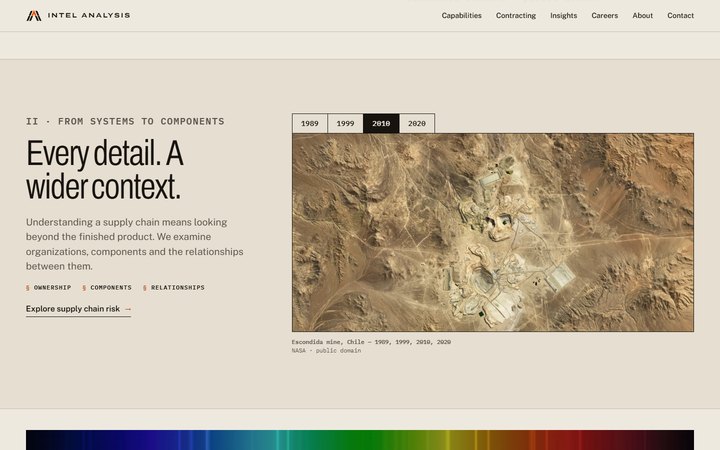
  1. 18Assay A museum catalogue of minerals Deciphering and the record. A museum catalogue on archival paper: a ridge resolved into its mineral map, early periodic-table drafts, emission spectra as dividers, one mine recorded across three decades. Look for Archival paper, a mineral map, early periodic-table drafts, one mine across three decades. ArchivalSpecimen platesRecord by year
  2. 17Manifest The supply chain at dusk The supply chain at dusk. A harbour film with a shipping-manifest strip of the firm's real identifiers, then a scroll-driven chain: component, board, factory, rail, waterway. Look for A harbour film with a manifest strip of the firm’s real identifiers, then a scroll-driven chain. Dusk gradeScroll chainManifest fields
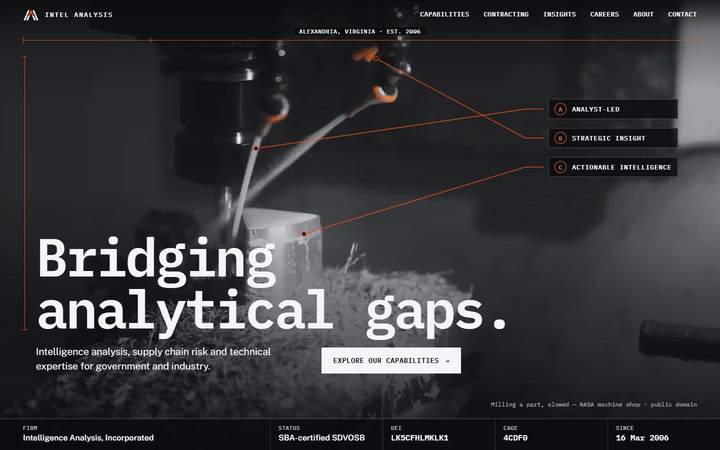
  3. 16Tolerance Set like a technical drawing Precision engineering set like a technical drawing. Slow-motion milling film; dimension lines carry the real UEI, CAGE and founding date; leader lines point the brand pillars into the film. Look for Slow-motion milling film; dimension lines carry the real UEI, CAGE and founding date. Graphite gradeDimension linesMono lettering
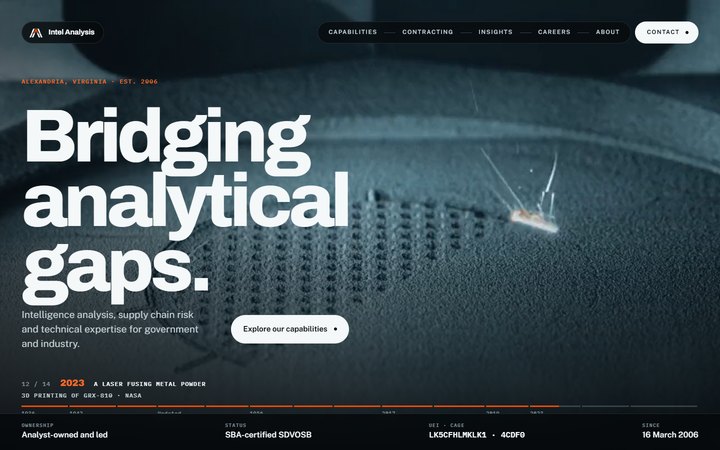
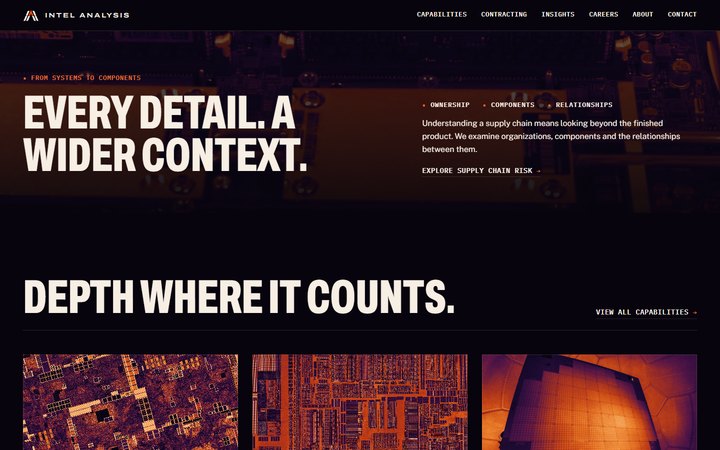
  4. 15Resolve Technology up close, thermal palette Technology up close, no space. A laser 3D-printing film and chip-die micrographs in a thermal-imaging palette; every image locks in from coarse blocks to full detail. Look for Laser 3D-printing film and chip micrographs; each image locks in from coarse blocks to detail. Thermal gradeBlock resolveDie micrographs
  5. 14First Light Orbital sunrise Opens on a 4K orbital sunrise that plays once; the headline arrives with the light. The page moves from night into daylight, in true colour. Look for A 4K sunrise from orbit plays once; the headline arrives with the light. Natural colourSunrise filmLight sweep
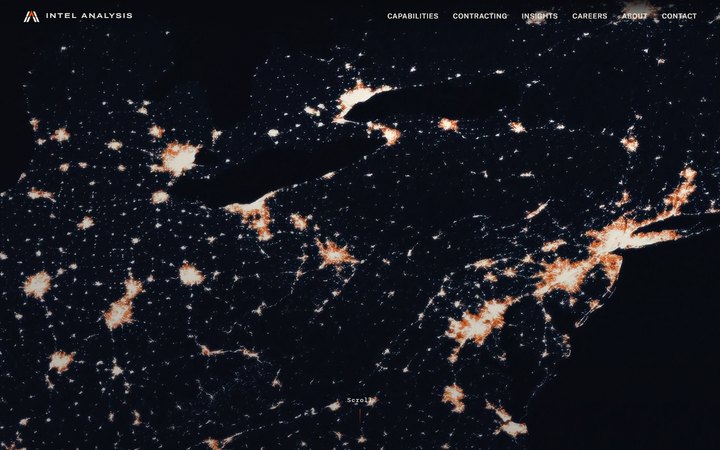
  6. 13Night Shift Through the mark, into the night The night seen through the iAi mark: scroll flies through the mark into NASA Black Marble film. City lights from the ISS switch on as they arrive. Look for Scroll flies through the iAi mark into night-time Earth; city lights switch on as they arrive. Night gradeMark apertureBlack Marble film
  7. 12From Orbit to Origin Paper, ink and halftone Paper and ink. Plates printed as halftone, resolving to tone; a descent from port to ore; forty years of Landsat scrubbed by scroll. Look for Halftone plates resolving to tone; forty years of Landsat scrubbed by scroll. Print gradeHalftone platesLandsat scrub
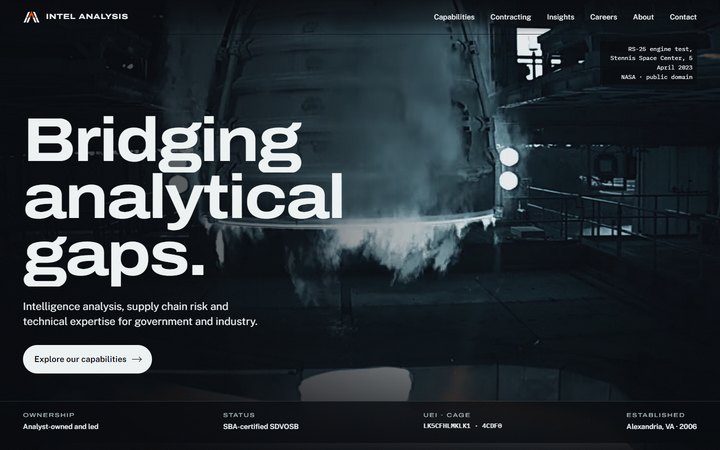
  8. 11House Grade The first house grade Archival engine-test film behind the headline, house-graded industrial photography, stills that reveal once and hold still. Look for Archival engine-test film and house-graded photography. NASA · HAER archivalHouse gradeHero film loop

Side by side

Compare any two.

Choose two concepts and a page; both load live, scaled from a desktop view.

About these concepts

Same words, same facts

Every concept uses Intel Analysis, Inc.’s approved copy and only verified facts — the legal name Intelligence Analysis, Incorporated, UEI LK5CFHLMKLK1, CAGE 4CDF0, SBA-certified SDVOSB status, founded 16 March 2006. No customer is named anywhere.

Images you can use

All imagery is public domain or CC0 — NASA, the Library of Congress, the National Archives, the Prelinger Archives, USDA, Wikimedia Commons — or made for the site. Each concept lists its sources on its “Image credits” page.

What these are not, yet

They are previews. Forms show a confirmation but send nothing; pages are hidden from search engines. The chosen direction becomes the production site: content managed in Sanity, forms routed to email, full accessibility and performance work.